
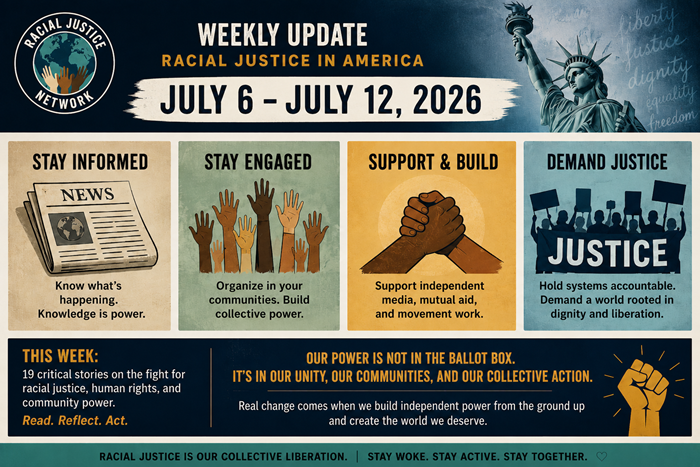
Vernellia R. Randall, Weekly Racial Justice Update — July 6–12, 2026, Racism.org (July 13, 2026).
Federal and state efforts to control racial education, weaken civil-rights enforcement, reshape election administration, restrict birthright citizenship, and narrow honest accounts of United States history were met by court rulings, litigation, organizing, and community resistance.
This update covers developments reported or occurring from Monday, July 6, through Sunday, July 12, 2026. It includes court decisions, government actions, racial disparities, deaths requiring public accountability, voting-rights organizing, immigrant-rights litigation, Tribal sovereignty, Native education, anti-Muslim discrimination, and Native Hawaiian self-determination.
The numbered sections are provided only for navigation. They do not rank one life, community, or issue above another.
Table of Contents
- Federal Appeals Court Blocks Florida’s Higher-Education Classroom Censorship
- Federal Appeals Court Revives Challenge to South Carolina’s Curriculum Censorship
- Faculty Groups Sue Texas Tech over Restrictions on Teaching Race, Gender, and Sexual Orientation
- New Mexico Report Documents Severe Racial Disparities in School Discipline
- EEOC Removes Longstanding Affirmative-Action Guidance and Signals a Wider Rollback
- Federal Pressure on State Election Administration Intensifies
- NAACP Announces a $20 Million Black Voter-Mobilization Campaign
- Nolan Xavier Wells’s Family Seeks an Independent Autopsy and a Transparent Investigation
- Tyrin Johnson’s Family Demands Video as Memphis Task Force Records a Second Fatal Shooting in Four Days
- Fatal ICE Shooting in Houston Brings Demands for an Independent Investigation
- Trump Announces He Will Seek Rehearing After Supreme Court Upholds Birthright Citizenship
- Federal Court Orders USCIS to Resume Work-Permit Processing for Immigrants from Targeted Countries
- New Federal Housing Law Adds Reforms but Leaves Major Racial-Equity and Tribal Gaps
- Prairie Band Potawatomi Nation Sues Kansas to Defend Tribal Sovereignty
- Federal Wild-Horse Roundup Proceeds over Tribal Cultural and Consultation Objections
- Bureau of Indian Education Schools Show Major Graduation Gains—and New Risks
- Civil-Rights Coalition Defends CAIR Against Florida’s “Terrorist” Designation
- Native Hawaiian and Molokaʻi Protesters Force a Pause in Kalaupapa Tours
- White House Report Attacks Smithsonian Accounts of Native Dispossession and Racial History
- Bottom Line
- Search Note
1. Federal Appeals Court Blocks Florida’s Higher-Education Classroom Censorship
On July 7, the U.S. Court of Appeals for the Eleventh Circuit affirmed a preliminary injunction blocking the higher-education provisions of Florida’s Stop W.O.K.E. Act. The 2–1 decision held that the law’s restrictions on what public-college and university instructors could say about race, sex, and inequality amounted to unconstitutional viewpoint discrimination. The court rejected Florida’s argument that professors’ classroom speech automatically becomes government speech simply because the state pays their salaries.
The ruling does not invalidate every part of the statute. It addresses the provisions governing public higher education. Even so, it is a substantial rejection of a state effort to suppress disfavored ideas about racial and gender hierarchy in college classrooms.
Why It Matters
The decision protects more than abstract academic freedom. Laws that prohibit instructors from explaining structural racism, privilege, or historical inequality do not produce neutral education; they give government officials power to determine which accounts of racial history may be taught. The ruling recognizes that public universities cannot function as centers of inquiry when elected officials may punish professors for presenting ideas the state dislikes.
Sources
- American Civil Liberties Union, “Federal Appeals Court Strikes Down Florida’s Unconstitutional Classroom Censorship Law” (July 7, 2026), https://www.aclu.org/press-releases/federal-appeals-court-strikes-down-floridas-unconstitutional-classroom-censorship-law (last visited July 13, 2026).
- Justia, “Pernell v. Commissioner of the Florida State Board of Education,” Nos. 22-13992 and 23-10616 (11th Cir. July 7, 2026), https://law.justia.com/cases/federal/appellate-courts/ca11/23-10616/23-10616-2026-07-07.html (last visited July 13, 2026).
- Legal Defense Fund, “Federal Appeals Court Strikes Down Florida’s Unconstitutional Classroom Censorship Law” (July 7, 2026), https://www.naacpldf.org/press-release/federal-appeals-court-strikes-down-floridas-unconstitutional-classroom-censorship-law/ (last visited July 13, 2026).
2. Federal Appeals Court Revives Challenge to South Carolina’s Curriculum Censorship
On July 8, the U.S. Court of Appeals for the Fourth Circuit reversed the dismissal of a federal civil-rights lawsuit challenging a South Carolina budget provision that restricts the use of state funds to teach certain ideas about race and sex. The plaintiffs include the South Carolina State Conference of the NAACP, Black public-school students, and author Ibram X. Kendi. They allege that the provision contributed to the removal of an Advanced Placement African American Studies course from the state curriculum and the removal of one of Kendi’s books from school libraries.
The appeals court did not decide whether the provision is constitutional. It held that the plaintiffs had adequately alleged injuries that could be addressed by the courts and returned the case to the federal district court for further proceedings.
Why It Matters
The ruling prevents a challenge to government censorship of racial history from being ended before the evidence and constitutional claims are heard. It also distinguishes a procedural victory from a final merits ruling: South Carolina’s restrictions remain contested, but the students and organizations affected by them may continue seeking judicial relief.
Sources
- Justia, “South Carolina State Conference of the NAACP v. Weaver,” No. 25-2216 (4th Cir. July 8, 2026), https://law.justia.com/cases/federal/appellate-courts/ca4/25-2216/25-2216-2026-07-08.html (last visited July 13, 2026).
- Legal Defense Fund, “Federal Appeals Court Revives Challenge to South Carolina’s Curriculum Censorship Law” (July 8, 2026), https://www.naacpldf.org/press-release/federal-appeals-court-revives-challenge-to-south-carolinas-curriculum-censorship-law/ (last visited July 13, 2026).
3. Faculty Groups Sue Texas Tech over Restrictions on Teaching Race, Gender, and Sexual Orientation
On July 8, the American Association of University Professors and the Texas AAUP-AFT filed a federal lawsuit against the Texas Tech University System’s chancellor and Board of Regents. The lawsuit challenges directives restricting course content concerning race, sexual orientation, and gender identity. Faculty members allege that the policies require reviews of syllabi and teaching materials, prohibit some graduate research, and have resulted in the removal or suspension of materials needed to teach history, law, philosophy, and health care.
The complaint alleges viewpoint discrimination and violations of the First and Fourteenth Amendments. It also alleges that the directives particularly burden Black faculty and suppress materials by or about Black people. Texas Tech officials maintain that the policies are lawful, constitutionally sound, and intended to comply with state law. No court has ruled on the claims.
Why It Matters
The lawsuit shows how restrictions written in broad language can reshape entire courses before a court ever reviews them. Mandatory disclosure, automated syllabus screening, and prior approval requirements can cause professors to remove contested material rather than risk discipline. The result is not simply less discussion of race; it is government control over which histories, authors, patients, and legal doctrines students are permitted to study.
Sources
- Courthouse News Service, “Faculty Unions Accuse Texas Tech of Lecture Hall Censorship” (July 8, 2026), https://www.courthousenews.com/faculty-unions-accuse-texas-tech-of-lecture-hall-censorship/ (last visited July 13, 2026).
- Lambda Legal, “Legal Advocates Sue Texas Tech over Censorship Policies Targeting Race, Sexual Orientation, and Gender Identity” (July 8, 2026), https://lambdalegal.org/newsroom/aaup_tx_20260708_legal-advocates-sue-texas-tech-over-censorship-policies-targeting-race-sexual-orientation-gender-identity/ (last visited July 13, 2026).
- Legal Defense Fund, “AAUP, Texas AAUP-AFT Sue Texas Tech University System over Restrictive Course Content Policies” (July 8, 2026), https://www.naacpldf.org/press-release/aaup-texas-aaup-aft-sue-texas-tech-university-system-over-restrictive-course-content-policies/ (last visited July 13, 2026).
- Texas AFT, “AAUP, Texas AAUP-AFT Sue Texas Tech University System over Restrictive Course Content Policies” (July 8, 2026), https://www.texasaft.org/post/aaup-texas-aaup-aft-sue-texas-tech-university-system-over-restrictive-course-content-policies (last visited July 13, 2026).
4. New Mexico Report Documents Severe Racial Disparities in School Discipline
A July report from the New Mexico Department of Justice found that Gallup-McKinley County Schools imposes some of the state’s highest levels of exclusionary discipline and disproportionately removes Native American and Hispanic students from school. Across multiple years and datasets, Native American students lost approximately eight to ten times as many school days to out-of-school suspension as white students, while Hispanic students lost approximately three to four times as many. The report also found harsher consequences for similar infractions.
The Department traced the disparities in part to vague misconduct categories, broad administrative discretion, weak data practices, and policies that do not adequately address racialized aggression. The district previously relied on an outside audit that concluded there was no disproportionate impact on Native students, but the Department found that the audit’s methodology obscured disparities by comparing Native students with all other students combined rather than directly with white students.
Why It Matters
Exclusionary discipline is a denial of instructional time. When Native and Hispanic students are removed from school more often and punished more harshly for comparable conduct, the disciplinary system reproduces racial inequality through lost learning, isolation, and increased risk of later academic and economic harm. The report also demonstrates why racial data must be disaggregated rather than averaged in ways that conceal discrimination.
Sources
- Native News Online, “Report: Native American Students Face Harsher Discipline, Lost School Days at NM District” (July 7, 2026), https://nativenewsonline.net/education/report-native-american-students-face-harsher-discipline-lost-school-days-at-nm-district/ (last visited July 13, 2026).
- New Mexico Department of Justice, “Forced Out: How Exclusionary and Disparate Disciplinary Practices at Gallup-McKinley County Schools Rob Students of Instructional Time” (July 2026), https://nmdoj.gov/wp-content/uploads/nmdoj_gmcs_report_july_2026.pdf (last visited July 13, 2026).
- Source New Mexico, “New Mexico AG Investigation Finds Gallup Schools More Severely Discipline Native, Hispanic Students” (July 6, 2026), https://sourcenm.com/2026/07/06/new-mexico-ag-investigation-finds-gallup-schools-more-severely-discipline-native-hispanic-students/ (last visited July 13, 2026).
5. EEOC Removes Longstanding Affirmative-Action Guidance and Signals a Wider Rollback
On July 6, the Equal Employment Opportunity Commission published a final interpretive rule rescinding its 1979 guidelines on affirmative action under Title VII. Those guidelines had explained when employers could voluntarily examine workplace barriers and adopt lawful measures to improve employment opportunities for women and racial minorities. The Commission said the guidance was obsolete, inconsistent with Title VII, and insufficiently aligned with later court decisions.
The same day, the EEOC released a regulatory agenda containing additional proposed changes, including ending its annual collection of workplace demographic data and withdrawing guidance warning that English-only workplace rules may be discriminatory. Those proposals are not yet final, but they show the direction of the agency’s enforcement policy.
Why It Matters
Removing the guidelines does not erase Title VII or make all voluntary affirmative-action efforts unlawful. It does, however, eliminate a longstanding federal framework that gave employers clearer guidance for identifying and correcting entrenched exclusion. Ending demographic-data collection would further reduce the information available to detect patterns that individual complaints may not reveal. Together, these actions move the EEOC away from addressing structural inequality and toward a narrower, formally “colorblind” enforcement model.
Sources
- Associated Press, “Ex-Civil Rights Agency Commissioner Fired by Trump Drops Lawsuit” (July 6, 2026), https://apnews.com/article/equal-employment-commissioner-fired-lawsuit-5fae543c35a27467a99a8b20c8291207 (last visited July 13, 2026).
- Equal Employment Opportunity Commission, “Rescission of Guidelines on Affirmative Action Appropriate Under Title VII of the Civil Rights Act of 1964, as Amended,” 91 Federal Register 40879 (July 6, 2026), https://www.federalregister.gov/documents/2026/07/06/2026-13637/rescission-of-guidelines-on-affirmative-action-appropriate-under-title-vii-of-the-civil-rights-act (last visited July 13, 2026).
6. Federal Pressure on State Election Administration Intensifies
During the week, the Department of Justice sent letters to election officials in all fifty states and the District of Columbia warning that officials could face criminal liability if they knowingly kept noncitizens on voter rolls or permitted them to vote. The letters demanded a response within five days. The administration also tied portions of federal antiterrorism grants to election-related conditions, including citizenship verification and changes in voting technology.
On July 9, President Donald Trump removed the two Democratic members of the bipartisan U.S. Election Assistance Commission, while its remaining Republican commissioner resigned. The departures left the four-member commission with no sitting commissioners. The Commission helps administer federal election grants, oversees testing and certification of voting systems, and maintains the national mail voter-registration form.
Why It Matters
Noncitizen voting is already illegal and documented cases are rare. The concern is not whether election officials should maintain accurate rolls; they should. The concern is the use of prosecution threats, grant conditions, and personnel removals to increase presidential influence over election administration that the Constitution largely assigns to states and Congress. These actions may also encourage rushed voter-list removals that disproportionately burden naturalized citizens, Latino voters, Asian American voters, and other citizens whose records are more likely to be questioned or mismatched.
Sources
- Associated Press, “The Trump Administration Is Ramping Up Pressure on States to Change Election Practices” (July 8, 2026), https://apnews.com/article/trump-voting-threat-states-3ec6b7838c97342965416756c0b83496 (last visited July 13, 2026).
- Associated Press, “Trump Fires Election Commission Members Ahead of November Midterms” (July 10, 2026), https://apnews.com/article/trump-fires-election-commission-members-0dc1f37c3990398b3085f22a14ea239a (last visited July 13, 2026).
- Reuters, “U.S. Justice Department Tells State Officials They Could Be Prosecuted over Noncitizen Voting” (July 8, 2026), https://www.reuters.com/legal/government/us-justice-department-tells-state-officials-they-could-be-prosecuted-over-2026-07-08/ (last visited July 13, 2026).
- Reuters, “Trump Fires Election Assistance Commission Members Ahead of Midterms” (July 10, 2026), https://www.reuters.com/legal/government/trump-terminates-election-assistance-commission-members-2026-07-10/ (last visited July 13, 2026).
- Votebeat, “Trump Fires Election Assistance Commission Members, Leaving Agency Without Leadership” (July 9, 2026; updated July 10, 2026), https://www.votebeat.org/national/2026/07/09/trump-fires-election-assistance-commission-members-hicks-hovland-mccormick/ (last visited July 13, 2026).
7. NAACP Announces a $20 Million Black Voter-Mobilization Campaign
On July 6, the NAACP announced that it will spend $20 million on voter mobilization before the November 2026 midterm elections. The organization described the project as its largest-ever investment in a midterm cycle. Working with GSSA, it plans to recruit 20,000 volunteers and reach 6.5 million Black voters across fourteen states and thirty-three congressional districts.
The campaign combines voter contact with litigation and organizing already underway over executive orders, voter data, mail voting, and congressional maps. Its scope reflects a judgment that courtroom victories alone will not protect Black political power.
Why It Matters
Black voting rights are being contested through redistricting, voter-roll practices, proof-of-citizenship demands, changes in election administration, and attacks on the Voting Rights Act. A large mobilization campaign is therefore both defensive and constructive: it seeks to prevent disenfranchisement while building enough participation to influence policy. Its impact will depend on sustained local organizing, accurate voter information, and the ability to reach voters who are discouraged or distrustful of political institutions.
Sources
- Capital B, “The NAACP Is Spending $20 Million to Mobilize Black Voters for the Midterms” (July 10, 2026), https://capitalbnews.org/naacp-black-voter-mobilization-midterms/ (last visited July 13, 2026).
- NAACP, “On 250th Anniversary of the U.S., the NAACP Announces $20 Million GOTV Campaign in Lead Up to the Midterms” (July 6, 2026), https://naacp.org/articles/250th-anniversary-us-naacp-announces-20-million-gotv-campaign-lead-midterms (last visited July 13, 2026).
- TheGrio, “NAACP Marks America’s 250th Birthday with Record $20 Million Campaign to Mobilize Millions of Black Voters” (July 10, 2026), https://thegrio.com/2026/07/10/naacp-20-million-gotv-campaign-2026-midterms/ (last visited July 13, 2026).
8. Nolan Xavier Wells’s Family Seeks an Independent Autopsy and a Transparent Investigation
Nolan Xavier Wells, an 18-year-old Black college student and football player, went to Horn Island, Mississippi, with friends on July 4 and did not return with them. His body was found on July 6. The Jackson County Sheriff’s Office said investigators did not then suspect foul play, requested witnesses and recordings from the island, and continued investigating. An official autopsy was performed, but its results had not been released by the end of the week.
Wells’s family retained civil-rights attorney Ben Crump and called for a thorough and transparent investigation, an independent autopsy, and release of records and witness information. The family and its attorneys identified unresolved questions involving conflicting accounts about whether Wells left the island, the location of his phone and keys, and other circumstances preceding his death. Some recordings and claims circulating online remained unverified, and no final cause or manner of death had been publicly established.
Why It Matters
The racial-justice issue is not a conclusion about who caused Wells’s death. It is whether the death of a young Black man will receive the same urgency, scrutiny, transparency, and presumption that unanswered questions matter that would be expected in other cases. The family’s demand for an independent review reflects the longstanding distrust created when missing Black people and suspicious Black deaths receive delayed, incomplete, or dismissive treatment.
Sources
- Associated Press, “Family of Mississippi Teen Who Died after July 4 Trip Calls for Transparency and Deeper Investigation” (July 10, 2026), https://apnews.com/article/nolan-wells-autopsy-mississippi-death-crump-sharpton-d6a9efbecbe2e0b2c6f1edfd86de50a5 (last visited July 13, 2026).
- NewsOne, “Nolan Xavier Wells: Questions We Still Need Answered About His Death” (July 7, 2026), https://newsone.com/6865371/nolan-xavier-wells-questions-we-still-need-answered-about-his-death/ (last visited July 13, 2026).
- The Washington Post, “Independent Autopsy Planned in Mississippi Drowning Case” (July 10, 2026), https://www.washingtonpost.com/nation/2026/07/10/independent-autopsy-planned-mississippi-drowning-case/ (last visited July 13, 2026).
9. Tyrin Johnson’s Family Demands Video as Memphis Task Force Records a Second Fatal Shooting in Four Days
On July 6, the family of Tyrin Johnson, a 20-year-old Black man fatally shot the previous day by two Tennessee National Guard members assigned to the Memphis Safe Task Force, demanded release of video evidence. Police said Johnson turned toward the Guard members with a gun while fleeing after a report of gunfire. His family questioned that account and called for a transparent investigation. The Tennessee Bureau of Investigation is investigating, and no final determination had been made by the end of the week.
On July 8, a Drug Enforcement Administration agent assigned to the same task force fatally shot another man while agents served a drug warrant at a hotel. An initial U.S. Marshals Service statement said the man pointed a handgun at officers, while a later state investigative statement said only that the encounter escalated and the agent fired into the room. It was the task force’s second fatal shooting in four days and the fourth death involving the unit since it began operating in September 2025.
Why It Matters
The deaths raise questions about deploying military personnel and a multiagency federal force into a majority-Black city under the language of crime control. Transparency is especially urgent when Guard members may lack body cameras and when different agencies release different accounts. Public safety cannot be evaluated only by arrests or weapons recovered; it must also account for deaths, civil-rights complaints, community fear, and whether residents can obtain reliable evidence about the force used in their neighborhoods.
Sources
- Associated Press, “The Family of a Man Shot by the Tennessee National Guard Demands Release of Video” (July 6, 2026), https://apnews.com/article/memphis-national-guard-shooting-tyrin-johnson-6a1ea3e51176d8ddf6519f900eccb16c (last visited July 13, 2026).
- Associated Press, “Second Person in Four Days Is Fatally Shot in Memphis by Federal Task Force Member” (July 8, 2026), https://apnews.com/article/memphis-shooting-task-force-federal-eea039cff91552f547359dd4acd32e04 (last visited July 13, 2026).
- Legal Defense Fund, “LDF Calls for Transparency in National Guard Killing of Tyrin Johnson” (July 8, 2026), https://www.naacpldf.org/press-release/ldf-calls-for-transparency-in-national-guard-killing-of-tyrin-johnson/ (last visited July 13, 2026).
- Tennessee Lookout, “National Guard Troops on Patrol in Memphis Fatally Shoot 20-Year-Old Man, According to TBI” (July 6, 2026), https://tennesseelookout.com/2026/07/06/national-guard-troops-on-patrol-in-memphis-fatally-shoot-20-year-old-man-according-to-tbi/ (last visited July 13, 2026).
10. Fatal ICE Shooting in Houston Brings Demands for an Independent Investigation
On July 7, an Immigration and Customs Enforcement officer fatally shot Lorenzo Salgado Araujo, a fifty-two-year-old Mexican immigrant and construction worker, during an enforcement operation in Houston’s predominantly Latino East End. ICE said Salgado Araujo struck an agency vehicle, refused commands, and tried to drive toward an officer, who fired in self-defense. Reuters reported that it could not independently verify the circumstances, and no video of the shooting itself had emerged by the following day.
More than a thousand people marched in Houston on July 8, and Salgado Araujo’s family, Latino civil-rights leaders, elected officials, and community members called for an independent and transparent investigation. Reporting by the Texas Tribune placed the shooting within a broader shift toward more ICE arrests in homes and public spaces, including a sharp increase in such arrests in Houston.
Why It Matters
The unresolved facts require caution, but the case raises immediate questions about force, transparency, and accountability in civil immigration enforcement. Public and residential arrests place armed federal agents directly into neighborhoods, often in unmarked vehicles and without the local oversight that ordinarily accompanies policing. When an agency involved in a fatal encounter also controls much of the evidence and investigation, affected communities have reason to demand independent review.
Sources
- Associated Press, “ICE Shooting in Houston Prompts Calls for an Independent Probe” (July 8, 2026), https://apnews.com/article/ice-houston-shooting-lorenzo-salgado-araujo-2d01ba69caf2445f05005096891ba5b2 (last visited July 13, 2026).
- Reuters, “Fatal ICE Shooting in Houston Sparks Demands for Transparency, Independent Investigation” (July 8, 2026), https://www.reuters.com/world/americas/fatal-ice-shooting-houston-sparks-demands-transparency-independent-investigation-2026-07-08/ (last visited July 13, 2026).
- Texas Tribune, “Houston ICE Killing Follows Increase in Street Arrests” (July 10, 2026), https://www.texastribune.org/2026/07/10/ice-arrest-data-texas-houston-shooting/ (last visited July 13, 2026).
11. Trump Announces He Will Seek Rehearing After Supreme Court Upholds Birthright Citizenship
On July 8, President Donald Trump announced that he would ask the U.S. Supreme Court to rehear Trump v. Barbara, the birthright-citizenship case the Court decided on June 30.
In a 6–3 decision, the Supreme Court held that the Fourteenth Amendment guarantees United States citizenship to children born in the United States when their parents are unlawfully present or are present under temporary legal status. The Court affirmed the judgment blocking Trump’s executive order restricting recognition of those children’s citizenship.
Trump called the decision wrong and said he would ask the Court for an immediate rehearing. As of July 13, the Supreme Court’s public docket did not show that the administration had filed a petition for rehearing.
The development during the July 6–12 coverage period was therefore Trump’s announcement that he intended to seek rehearing, not the filing of a completed petition.
Why It Matters
The Citizenship Clause was adopted after the Civil War to reject a system in which government could deny citizenship based on race, ancestry, parentage, or a subordinate legal status inherited at birth.
Trump’s proposed rehearing would continue his effort to create a class of children born in the United States who would be denied citizenship because of their parents’ immigration status. Although the Supreme Court rejected that position on June 30, the July 8 announcement shows that the administration has not accepted the constitutional ruling as the end of the dispute.
The announcement also keeps uncertainty and political pressure focused on children and families whose citizenship the Constitution protects. Birthright citizenship is not an immigration benefit granted at the government’s discretion. It is a constitutional status acquired at birth.
Sources
- Reuters, “Trump Says He Will Ask Supreme Court to Rehear Birthright Citizenship Case” (July 8, 2026), https://www.reuters.com/world/trump-says-he-will-ask-supreme-court-rehear-birthright-citizenship-case-2026-07-08/ (last visited July 13, 2026).
- Supreme Court of the United States, “Donald J. Trump, President of the United States, et al. v. Barbara, et al.,” No. 25-365, docket (updated through July 13, 2026), https://www.supremecourt.gov/docket/docketfiles/html/public/25-365.html (last visited July 13, 2026).
- Supreme Court of the United States, “Trump v. Barbara,” No. 25-365 (June 30, 2026), https://www.supremecourt.gov/opinions/25pdf/25-365_4hdj.pdf (last visited July 13, 2026).
12. Federal Court Orders USCIS to Resume Work-Permit Processing for Immigrants from Targeted Countries
On July 8, a federal magistrate judge in San Jose ordered U.S. Citizenship and Immigration Services to resume processing employment-authorization applications for 137 plaintiffs from fifteen countries, including Afghanistan, Iran, Nigeria, and Venezuela. The agency had frozen such applications for nationals of thirty-nine countries it classified as “high risk.” The plaintiffs said the delay threatened their ability to work, maintain immigration status, and support themselves and their families.
The judge rejected the government’s argument that the freeze was beyond judicial review and concluded that USCIS has a nondiscretionary duty to adjudicate immigration-benefit applications within a reasonable period. The order directly protects the named plaintiffs; it should not be described as a new nationwide order covering every affected applicant.
Why It Matters
A categorical freeze based on nationality converts administrative delay into a form of collective punishment. Work authorization determines whether immigrants can lawfully earn income, remain enrolled, obtain housing, and meet basic needs while their cases proceed. Judicial review is therefore essential when national-security labels are used to suspend ordinary legal processing for people from Africa, Asia, the Middle East, and Latin America without individualized findings.
Sources
- Courthouse News Service, “Citizenship and Immigration Services Ordered to Resume Processing Work Permit Applications” (July 8, 2026), https://courthousenews.com/citizenship-and-immigration-services-ordered-to-resume-processing-work-permit-applications/ (last visited July 13, 2026).
13. New Federal Housing Law Adds Reforms but Leaves Major Racial-Equity and Tribal Gaps
On July 11, the 21st Century ROAD to Housing Act became law without the President’s signature after the constitutional ten-day period expired. The broad legislation contains more than forty-five provisions addressing housing supply, manufactured housing, disaster recovery, small-dollar mortgages, home repairs, institutional investors, appraisal discrimination, and other housing issues.
Civil-rights and Tribal housing organizations identified meaningful provisions but also substantial gaps. The Legal Defense Fund warned that expanding housing resources without strong fair-housing enforcement could reproduce segregation and fail to reach Black communities. The National American Indian Housing Council reported that Tribes, Tribally Designated Housing Entities, and the Department of Hawaiian Home Lands are eligible under selected programs, but the law contains no dedicated Tribal housing title and does not reauthorize or modernize the Native American Housing Assistance and Self-Determination Act.
Why It Matters
Increasing housing supply is not the same as producing housing justice. Without enforceable safeguards, new development and financing can bypass communities historically excluded by redlining, appraisal discrimination, displacement, and unequal infrastructure investment. The law’s implementation will determine whether it reduces those inequalities or distributes new opportunities through the same institutions that created them.
Sources
- Legal Defense Fund, “LDF Urges States and Congress to Push for Fair Housing Enforcement and Compliance as the 21st Century ROAD to Housing Act Becomes Law” (July 11, 2026), https://www.naacpldf.org/press-release/ldf-urges-states-and-congress-to-push-for-fair-housing-enforcement-and-compliance-as-the-21st-century-road-to-housing-act-becomes-law/ (last visited July 13, 2026).
- National American Indian Housing Council, “The 21st Century ROAD to Housing Act Is Now Law: What It Means for Tribal Housing” (July 11, 2026), https://naihc.net/the-21st-century-road-to-housing-act-is-now-law/ (last visited July 13, 2026).
- Native News Online, “21st Century ROAD to Housing Act Becomes Law, Bringing New Opportunities but Limited Direct Changes for Tribal Housing” (July 12, 2026), https://nativenewsonline.net/currents/21st-century-road-to-housing-act-becomes-law-bringing-new-opportunities-but-limited-direct-changes-for-tribal-housing/ (last visited July 13, 2026).
14. Prairie Band Potawatomi Nation Sues Kansas to Defend Tribal Sovereignty
On July 6, the Prairie Band Potawatomi Nation filed a federal lawsuit against the executive director of the Kansas Lottery. The Nation alleges that Kansas is unlawfully selling lottery tickets and operating lottery machines at approximately two dozen locations within the Nation’s reservation without Tribal authorization. The complaint invokes the Indian Gaming Regulatory Act, the Nation’s gaming ordinance, treaty rights, and the Nation’s inherent authority to regulate activity on its lands.
The lawsuit also asks the court to declare that the roughly 900-square-mile reservation created by the Treaty of 1846 has never been diminished or disestablished. The Nation says it notified state officials and attempted to resolve the dispute before filing suit. No court has yet ruled on the merits.
Why It Matters
This is not merely a dispute over lottery revenue. It concerns whether a state may conduct and profit from gaming inside reservation boundaries while disregarding the Tribal government’s regulatory authority. The case also illustrates a recurring pattern in federal Indian law: states often exercise power as though reservation boundaries or treaty promises have disappeared, leaving Native nations to litigate for recognition of sovereignty the United States already pledged to respect.
Sources
- Native News Online, “Prairie Band Potawatomi Nation Sues Kansas Lottery, Alleges Violations of Tribal Sovereignty” (July 8, 2026), https://nativenewsonline.net/sovereignty/prairie-band-potawatomi-nation-sues-kansas-lottery-alleges-violations-of-tribal-sovereignty/ (last visited July 13, 2026).
- Prairie Band Potawatomi Nation, “Prairie Band Potawatomi Nation Files Federal Lawsuit Against State of Kansas” (July 8, 2026), https://www.pbpindiantribe.com/prairie-band-potawatomi-nation-files-federal-lawsuit-against-state-of-kansas (last visited July 13, 2026).
- Turtle Talk, “Prairie Band Potawatomi Sues to Stop Kansas Lottery on Indian Lands” (July 8, 2026), https://turtletalk.blog/2026/07/08/prairie-band-potawatomi-sues-to-stop-kansas-lottery-on-indian-lands/ (last visited July 13, 2026).
15. Federal Wild-Horse Roundup Proceeds over Tribal Cultural and Consultation Objections
From July 8 through July 10, the U.S. Forest Service gathered 461 wild horses from the Montgomery Pass area near Mono Lake. The Forest Service said a 2024 survey counted at least 694 horses—well above the designated management level—and that horses outside the territory were damaging sensitive habitat and creating safety risks. The agency used helicopters and transported the gathered horses to off-range facilities for veterinary review and adoption preparation.
The Utu Utu Gwaitu Paiute Tribe and Native cultural advocates sought to delay the roundup, describing the horses as sacred relatives and living parts of Tribal culture. They called for nonlethal fertility management, co-management, and meaningful government-to-government consultation. A federal court denied an emergency request to stop the operation on July 7, but the underlying lawsuit remained active.
Why It Matters
The dispute cannot be reduced to a disagreement about animal management. It concerns whether federal agencies may define environmental necessity and proceed on ancestral lands without the degree of Tribal consent, cultural protection, and shared governance Native nations demand. Consultation after an agency has effectively decided what it will do is not the same as co-management or respect for sovereignty.
Sources
- Native News Online, “‘They’re Raping the Land’: Massive Wild Horse Roundup Proceeds on Ancestral Native Lands” (July 10, 2026; updated July 12, 2026), https://nativenewsonline.net/environment/theyre-raping-the-land-massive-wild-horse-round-up-proceeds-on-ancestral-native-lands/ (last visited July 13, 2026).
- U.S. Forest Service, Inyo National Forest, “Wild Horses” (updated July 11, 2026), https://www.fs.usda.gov/r05/inyo/natural-resources/range/wild-horses (last visited July 13, 2026).
16. Bureau of Indian Education Schools Show Major Graduation Gains—and New Risks
Associated Press reporting published July 12 examined substantial graduation gains across schools overseen by the Bureau of Indian Education. The four-year graduation rate increased from slightly more than half of students in 2015 to a record 79 percent in 2025. At Chief Leschi Schools on the Puyallup Reservation, the reported rate rose from 53 percent in 2019 to 87 percent in 2025.
Educators attributed gains to local strategies, including career and technical education, stronger connections between coursework and community needs, teacher development, and improved student engagement. Changes in data collection also corrected reporting practices that had understated graduation. The reporting cautioned that federal restructuring, Department of Education changes, and earlier staffing and funding cuts could threaten continued progress.
Why It Matters
The gains challenge deficit narratives that treat Native students as the problem. Schools improve when Native students receive culturally grounded education, meaningful career pathways, stable staffing, and accurate data. The policy question is whether the federal government will sustain those conditions or claim credit for progress while weakening the institutions and resources that helped produce it.
Sources
- Associated Press, “Innovation, Data Fixes Fuel Native American Graduation Gains at Federally Funded Schools” (July 12, 2026), https://apnews.com/article/native-american-students-graduation-rates-education-trump-35e798ad1f75bd20d723aaa30dd729ee (last visited July 13, 2026).
- U.S. Department of the Interior, “Department of the Interior Announces Record Graduation Rates at Bureau of Indian Education Schools” (January 15, 2026), https://www.bia.gov/news/department-interior-announces-record-graduation-rates-bureau-indian-education-students (last visited July 13, 2026).
17. Civil-Rights Coalition Defends CAIR Against Florida’s “Terrorist” Designation
On July 9, the Legal Defense Fund, the Fred T. Korematsu Center for Law and Equality, and ten other nonprofit organizations filed an amicus brief in CAIR v. DeSantis. The case challenges a Florida executive order that labels the Council on American-Islamic Relations a “terrorist” organization and restricts state and local benefits, contracts, and other relationships involving CAIR and people accused of supporting it.
A federal district court issued a preliminary injunction blocking the order, and Florida appealed to the Eleventh Circuit. The amici argue that the order rests on Islamophobic stereotypes, punishes protected association, and repeats a long history of governments using national-security labels to suppress civil-rights organizations and marginalized communities. These are the amici’s arguments; the appellate court has not yet issued a final merits decision.
Why It Matters
Government power to label a domestic civil-rights organization “terrorist” without an ordinary criminal process threatens speech, association, legal advocacy, charitable work, and public participation. The immediate target is a Muslim organization, but the precedent could reach immigrant organizations, racial-justice groups, protest movements, and any nonprofit disfavored by state officials. The case therefore concerns both anti-Muslim discrimination and the broader use of security law to disable dissent.
Sources
- Knight First Amendment Institute at Columbia University, “CAIR Foundation v. DeSantis” (case page updated July 9, 2026), https://knightcolumbia.org/cases/cair-foundation-v-desantis (last visited July 13, 2026).
- Legal Defense Fund, “Civil Rights and Nonprofit Organizations File Amicus Brief Defending CAIR’s First Amendment Rights” (July 9, 2026), https://www.naacpldf.org/press-release/civil-rights-and-nonprofit-organizations-file-amicus-brief-defending-cairs-first-amendment-rights/ (last visited July 13, 2026).
18. Native Hawaiian and Molokaʻi Protesters Force a Pause in Kalaupapa Tours
On July 9, approximately two dozen Molokaʻi residents and Native Hawaiian community leaders protested the National Park Service’s launch of ranger-led public tours at Kalaupapa National Historical Park. Protesters briefly blocked access to the trail and said the federal agency had moved forward without adequate community consultation. By July 11, the National Park Service had temporarily paused future public tours while reassessing visitor access.
Kalaupapa is not an ordinary tourist site. Thousands of people with Hansen’s disease, most of them Native Hawaiian, were forcibly isolated there under government authority. The dispute also concerns who has the right to operate tours. A former patient had operated the prior tour company, and a 1995 lease provides that Native Hawaiians receive the next opportunity to run commercial tours on Department of Hawaiian Home Lands property when no former patient wishes to do so.
Why It Matters
The protest joined historical memory, land rights, and present-day self-determination. Federal stewardship does not erase the authority or interests of the people whose families suffered confinement and dispossession at the site. The temporary pause shows that direct community action can force consultation, but the underlying questions—who controls access, who benefits economically, and whose history governs the site—remain unresolved.
Sources
- Honolulu Civil Beat, “Protest Delays National Park Service’s Reopening of Kalaupapa Tours” (July 10, 2026; updated July 11, 2026), https://www.civilbeat.org/2026/07/protest-delays-national-park-services-reopening-of-kalaupapa-tours/ (last visited July 13, 2026).
- Hawaii News Now, “Molokai Activists Celebrate Kalaupapa Tour Pause; Future Still Uncertain” (July 11, 2026), https://www.hawaiinewsnow.com/2026/07/12/molokai-activists-celebrate-kalaupapa-tour-pause-future-still-uncertain/ (last visited July 13, 2026).
- SFGATE, “‘Shame on You’: Native Hawaiians Protest New Hawaii National Park Tour” (July 10, 2026), https://www.sfgate.com/hawaii/article/kalaupapa-protests-tour-22341028.php (last visited July 13, 2026).
19. White House Report Attacks Smithsonian Accounts of Native Dispossession and Racial History
During the week, conflict intensified over a White House report titled Saving America’s Story. The report was released on July 4 and examined the Smithsonian Institution’s museums, exhibits, educational materials, personnel, and leadership.
The report criticized Smithsonian exhibits and officials for discussing the United States as a nation shaped by stolen Native land, Indigenous removal, slavery, genocide, colonialism, racial inequality, and imperial power. It also criticized land acknowledgments, the Smithsonian’s treatment of Christopher Columbus and the Founders, and its engagement with the 1619 Project.
The report characterized some of these historical presentations as anti-American or ideologically distorted. It called for changes intended to emphasize patriotism and what the administration described as a more balanced presentation of the country’s history.
On July 9, Smithsonian Secretary Lonnie Bunch rejected what he described as an unfair characterization of the institution’s work. He defended the Smithsonian’s responsibility to present evidence, complexity, and multiple aspects of United States history.
Why It Matters
The dispute is about more than museum labels. It concerns whether political officials can use federal power to determine how a national cultural institution explains slavery, Native dispossession, conquest, segregation, and racial hierarchy.
An honest account of United States history must include achievement and resistance, but it cannot become honest by concealing forced removal, stolen land, enslavement, broken treaties, or government-supported racial oppression.
Calling documented history “anti-American” creates a political test for public scholarship. It pressures historians and museums to replace evidence with national celebration and to treat the experiences of Native peoples and other subordinated communities as threats to the national story.
Sources
- Native News Online, “White House Report Targets Smithsonian’s Treatment of Native History, Criticizes ‘Stolen Land’ Narrative” (July 6, 2026), https://nativenewsonline.net/currents/white-house-report-targets-smithsonians-treatment-of-native-history-criticizes-stolen-land-narrative/ (last visited July 13, 2026).
- Reuters, “Smithsonian Head Says White House Report Unfairly Characterized U.S. History” (July 9, 2026), https://www.reuters.com/legal/government/smithsonian-head-says-white-house-report-unfairly-characterized-us-history-2026-07-09/ (last visited July 13, 2026).
- The White House, “Saving America’s Story: A Report on the Smithsonian Institution” (July 4, 2026), https://www.whitehouse.gov/wp-content/uploads/2026/07/Smithsonian-Report-Saving-Americas-Story.pdf (last visited July 13, 2026).
Bottom Line
The week’s developments show racial hierarchy operating through many institutions at once: classroom rules, public history, employment policy, election administration, citizenship, immigration processing, federal policing, school discipline, housing programs, management of Native lands, and control over culturally significant places.
Courts provided important openings against classroom censorship, restrictions on birthright citizenship, and categorical immigration action. Most of the disputes, however, remain unresolved. Families continued demanding evidence and accountability where government descriptions of deaths were incomplete or contested.
The update also documents resistance and institutional capacity rather than reporting racial harm alone. Black civic organizations expanded voter mobilization. Native nations defended jurisdiction, culture, land, education, and treaty rights. Immigrant and Muslim advocates used litigation to challenge collective punishment and political labeling. Native Hawaiian and Molokaʻi residents forced federal officials to pause access plans for Kalaupapa.
The common issue is power: who makes the rules, whose evidence is accepted, whose history is taught, whose deaths receive serious investigation, who is recognized as a citizen, and whether affected communities possess meaningful authority over decisions that shape their lives.
Search Note
This update covers Monday, July 6, through Sunday, July 12, 2026. Research was conducted on July 13, 2026, through two separate tracks.
The first track searched courts, government agencies, civil-rights organizations, national and regional news organizations, legal publications, and primary documents.
The second track was an independent discovery scan of Black, Latino, Indigenous, Asian American and Pacific Islander, Arab American and Muslim, immigrant, Native Hawaiian, Pacific Islander, and other relevant community news sources. Developments discovered through community media were checked against primary documents or additional reporting when available.
No numerical limit was placed on the number of stories. Every adequately sourced development identified through the completed search and materially connected to racial justice was considered for inclusion. A matter was excluded only when it fell outside the July 6–12 coverage period, lacked sufficient verification, duplicated another item without adding a meaningful development, or was not materially related to racial justice. Inclusion and numbering do not establish a hierarchy of importance.
ChatGPT assisted with the two-track search and initial drafting. Vernellia R. Randall reviewed and edited the update for accuracy, context, coherence, and publication.