
Abstract
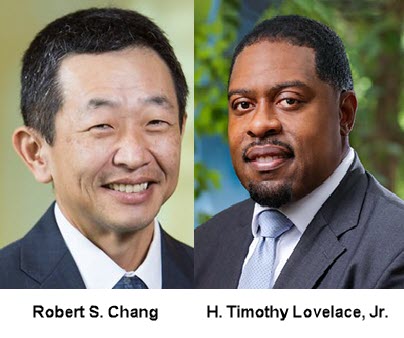
Excerpted From: Robert S. Chang and H. Timothy Lovelace, Jr., Who Owns Civil Rights History?, 106 B.U. L. Rev. 729 (April 2026) (412 Footnotes) (Full Document)
 There was a delicious irony when the plaintiff, Students for Fair Admissions (“SFFA”), in its challenges to race-conscious affirmative action admissions policies at the United States Military Academy (“West Point”) and the United States Naval Academy (“Naval Academy”), called upon the Supreme Court to mind the lessons of Korematsu v. United States--namely that “blind judicial deference to the military on questions of racial discrimination are 'gravely wrong,’ both legally and historically.” The complaints later stated that SFFA drew this lesson from the Court in Students for Fair Admissions, Inc. v. President & Fellows of Harvard College (“SFFA”). There was a less delicious irony when the plaintiff in SFFA advanced--and the Court accepted--that Brown v. Board of Education requires a rejection of affirmative action.
These claims are only sensical if we accept the revisionist civil rights history advanced by Chief Justice Roberts in SFFA. Roberts put forward a history that allowed him to double down on his earlier pronouncement in Trump v. Hawaii that Korematsu had been overruled in the court of history. This in turn completed the through line Roberts began early in his tenure on the Court that fidelity to Brown requires not just that we “stop discriminating on the basis of race,” but that “[e]liminating racial discrimination means eliminating all of it.”
This move by the Chief Justice allowed him to create distance between the racial evil of Korematsu and the animus at the heart of the travel ban established via an executive order legitimized in Trump, which set up the false equivalence advanced by SFFA in likening affirmative action in admissions to our nation’s service academies to the incarceration of Japanese Americans during World War II. Any and all differences in treatment on the basis of race are deemed equivalent evils. Under this logic, the constitutional error and evil at the heart of Japanese American incarceration during World War II is the same constitutional error and evil at the heart of race-conscious affirmative action.
Affirmative action advances racial justice; Japanese American incarceration was racial injustice. The two are incomparable, yet SFFA would have us think differently. In September 2023, in the wake of SFFA, SFFA sued West Point and the Naval Academy for the military academies’ use of affirmative action in admissions. SFFA’s lawsuits noted that the military academies provide racial preferences to “Hispanics,” “Asians,” and “African-Americans” in admissions so that the military can create a senior leadership that reflects the racial demographics of the country and the military’s enlisted ranks. SFFA asserted that these admissions practices violate the Fifth Amendment of the Constitution. However, SFFA made more explosive allegations. SFFA alleged that in Korematsu, the Supreme Court sanctioned Japanese American incarceration by deferring to the military’s consideration of race. SFFA maintained that permitting the military to consider race in military academy admissions would be akin to perpetuating the vile racism the Court legitimized during Japanese American incarceration. SFFA’s lesson was clear: Never trust the military when using race. The history of Korematsu was instructive. According to SFFA, such “blind deference to ... military necessity [on questions of racial discrimination] can lead to 'gravely wrong’ outcomes and gross violations of civil rights.”
All should be troubled by such use of Korematsu. This unfortunate analogy between Korematsu and affirmative action is much more than factually inaccurate; the comparison itself is deeply violent. Japanese American incarceration ripped families from their homes, businesses, and communities. The government herded Japanese Americans into overcrowded, dirty, barbed-wire-ringed camps located in desolate parts of the country. Incarcerated Japanese Americans often lived in tarpaper and wooden frame barracks, and these hastily and poorly built quarters subjected Japanese Americans to extreme weather, pests, and little personal privacy. They received inadequate healthcare and suffered from disease and premature death. The government stamped Japanese Americans as disloyal and national security threats but then forced them to pledge their allegiances to the U.S. flag. Japanese American incarceration was hell. SFFA’s mobilization of Korematsu trivializes the horrors of Japanese American incarceration and must be condemned as a bold affront to history and human dignity.
SFFA’s willingness to pervert the history of Japanese American incarceration is part of the organization’s broader attempt to co-opt civil rights history. SFFA’s purported mission “is to support and participate in litigation that will restore the original principles of our nation’s civil rights movement.” Throughout SFFA’s anti-affirmative action litigation, the organization has made many misleading or inaccurate statements about civil rights history. However, SFFA’s brand of litigation--one that relies heavily on historical analogies--begs larger theoretical questions: Who owns civil rights history and what role does law play in that ownership?
Law serves as a crucial site for the struggle for historical memory. It functions as a battleground where narratives about the past are constructed, contested, and legitimized. Courts and other legal institutions, because they have power, are able to construct authoritative narratives of the past through legal decisions. These legal decisions become repositories that help shape how societies remember and interpret historical moments. In this way, courts are able to affirm or reject certain interpretations of history. This view of the law is consistent with the notion of constitutional memory recently introduced by Professor Reva Siegel.
Law also operates as a crucial site for reparative justice, where collective memory can be reconciled or revised through legal mechanisms like public apologies, restitution, and compensation. Legal battles over reparations are not merely about financial compensation but also about publicly acknowledging historical wrongs and reconfiguring collective memory around those injustices. Such efforts allow courts to memorialize historical suffering and validate the lived experiences of marginalized communities.
This Article returns to civil rights history to explore several deep and rich ironies in SFFA’s anti-affirmative action lawsuits against West Point and the Naval Academy. SFFA’s claim that it wears the mantle and is the true torchbearer of the civil rights movement can only be made true through the violent erasure of history. SFFA’s argument misunderstands that affirmative action developed because of the civil rights movement--not despite the civil rights movement. Civil rights leaders supported affirmative action as a tool to address systemic inequality that persisted even after the military desegregated. They understood that true equality required more than just dismantling discriminatory laws. Equality also required proactive steps to level the playing field. Simply put, although SFFA claims to celebrate the civil rights icons and claims that it is restoring the original principles of ““our” civil rights movement, its anti-affirmative action lawsuits are rejecting the solutions proposed by the very leaders of the movement it heralds.
Suing the military academies to reclaim the legacy of the civil rights movement was perhaps a curious choice. The military was ground zero for affirmative action. Affirmative action in the military began in the 1960s as part of a broader federal effort to promote equal opportunity and advance U.S. national security interests. On the other hand, SFFA’s lawsuits against the military academies made perfect sense as the next logical step to stamp out race-conscious affirmative action in any guise given that the military academies were exempted from the Court’s ruling in SFFA. An additional consideration might come from the iconic role that the military academies, especially West Point, play in our nation’s history. West Point’s importance as a symbol made it a critical site for SFFA to carry forward its war against affirmative action.
This Article proceeds as follows. Part I explores the question of who owns civil rights history and the role that law plays in constructing that history. Part II then turns to civil rights history as narrated by Chief Justice Roberts in SFFA. The Courts opinion delivered by the Chief Justice, though containing a carve out for this nation’s service academies, nevertheless provides a version of civil rights history that allows SFFA in the current litigation to claim the mantle of the civil rights movement. Part III provides a mostly forgotten history of the origins of affirmative action in the military. In doing so, it refutes the notion that affirmative action was somehow aberrational or inconsistent with the civil rights movement’s original principles. Part IV offers implications for racial justice after SFFA. Last, Part V steps back to examine narratives of racial progress more generally.
[ . . . ]
The question of who owns civil rights history is neither abstract nor simply academic. In our precedent-based system, the majority gets to narrate its version of history that then becomes official. Legal opinions become the repositories of our nation’s collective memory. The litigants and the Justices in affirmative action cases vie with each other to make their version of our nation’s civil rights history the prevailing one. Because our Constitution was founded on the original sin of slavery, and despite the second founding in the form of the Reconstruction amendments, the question of what will be required to redeem the nation from the original sin and the persistent sin of white supremacy requires a fidelity to facts that is missing in the Court’s SFFA opinion. In taming Korematsu and twisting Brown, the Court has constructed a revisionist civil rights history, in some ways akin to what the Dunning School did in constructing a revisionist Reconstruction history. We offer this Article as a corrective.
Robert S. Chang is Professor of Law and Sylvia Mendez Presidential Chair for Civil Rights and Executive Director of the Fred T. Korematsu Center for Law and Equality at UC Irvine School of Law.
H. Timothy Lovelace, Jr. is Professor of Law and History and John Hope Franklin Research Scholar at Duke University School of Law.