
Vernellia R. Randall, Weekly Racial Justice Briefing — August 2–8, 2026, Racism.org (August 11, 2026).
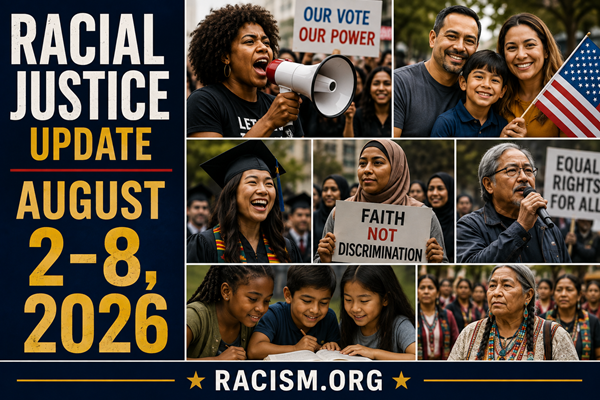
This week’s racial-justice developments show how broadly the struggle over race now reaches across American law and public life. From Supreme Court litigation over voting and renewed attacks on birthright citizenship to Confederate school names, Muslim religious land use, Black Lives Matter in the workplace, Indigenous sacred land, Native-language survival, and the rebuilding of Lahaina, the issues are different but the underlying question is often the same: who has power, who bears the burden of government decisions, and whose rights, history, land, and belonging are protected.
The week also shows why racial-justice reporting cannot stop with Supreme Court cases or national headlines. A separate search of Black, Latino, Indigenous, Asian American and Pacific Islander, Arab American and Muslim, immigrant, Native Hawaiian and Pacific Islander community news identified important developments that broader legal and national searches missed. There is no hierarchy in this listing. Together, these stories show racial justice being contested in courts, agencies, schools, workplaces, elections, religious institutions, Native communities, and local struggles over land and survival.
Table of Contents
- Supreme Court Mail-Voting Fight Advances Toward Emergency Decision
- Trump Issues New Orders Restricting Birthright Citizenship
- Federal Government Reaches 21 Consecutive Court Losses in Voter-Roll Campaign
- Federal Judge Rules Restoration of Confederate School Names Violated Black Students’ Civil Rights
- Justice Department Finds Duke Law School Used Race Unlawfully in Admissions
- Muslim Community Sues Oklahoma City Suburb Over Mosque Denial
- States and Civil-Rights Groups Challenge Sharing of Poor Families’ Data With Immigration Authorities
- NLRB Rules Whole Foods Could Prohibit Black Lives Matter Apparel
- Rare-Earth Mine Proposed Near Sacred Mato Tipila
- Osage Nation Closes Language-Immersion School Amid Budget Crisis
- Lahaina Recovery Raises Concerns About Displacement and Loss of Local Land
- Todd Blanche Confirmed as Attorney General Amid Concerns About Justice Department Independence
- Nationwide Voting-Rights Mobilization Marks Voting Rights Act Anniversary
- Bottom Line
- Search Note
1. Supreme Court Mail-Voting Fight Advances Toward Emergency Decision
The Supreme Court received major filings this week in Trump v. California, No. 26A124, the administration’s emergency effort to revive portions of President Trump’s executive order concerning mail voting, voter eligibility, and federal involvement in state election administration.
The administration originally sought Supreme Court intervention on July 27. During the covered week, the states and supporting amici filed their opposition on August 3, and the Solicitor General filed the government’s reply on August 4. The application remained pending at the end of August 8.
The dispute concerns provisions lower courts blocked that would expand federal involvement in voter-eligibility information and mail-ballot administration. The states argue that changing election procedures this close to the November 2026 elections would interfere with their constitutional authority and disrupt election systems already operating under established state law. The federal government argues, among other things, that the challenge is premature.
Why It Matters
This case is about more than election administration. It is about whether the federal executive branch can build a national system for questioning voter eligibility and interfere with state mail-ballot procedures immediately before an election.
Citizenship databases are not neutral simply because they are computerized. Errors in names, birth dates, immigration records, and government databases can place lawful voters at risk, particularly naturalized citizens and voters from immigrant communities.
The racial-justice question is straightforward: who bears the burden when government creates another system for deciding who must prove that they belong in the electorate?
Sources
- U.S. Supreme Court, Docket, Trump v. California, No. 26A124 (2026).
https://www.supremecourt.gov/docket/docketfiles/html/public/26a124.html
(Last Visited: August 11, 2026). - U.S. Supreme Court, Trump v. California, No. 26A124, Reply in Support of Application for Stay (August 4, 2026).
https://www.supremecourt.gov/DocketPDF/26/26A124/418107/20260804154959362_Trump%20v.%20California%20Reply_Final.pdf
(Last Visited: August 11, 2026).
2. Trump Issues New Orders Restricting Birthright Citizenship
President Trump issued two new executive orders seeking to restrict birthright citizenship after the Supreme Court rejected his earlier, broader effort to deny citizenship to children born in the United States to undocumented or temporarily present parents.
The new orders are narrower. They target several categories of children, including some children whose parents are classified as enemy aliens and circumstances the administration characterizes as “birth tourism.” Federal agencies were directed to develop implementation procedures.
Asian American and Pacific Islander organizations immediately condemned the new orders. AAPI legal and civic groups emphasized the Supreme Court’s recent ruling protecting birthright citizenship and connected the new restrictions to the history of exclusion directed at Asian immigrants and Asian Americans, including United States v. Wong Kim Ark and the incarceration of Japanese Americans during World War II.
Why It Matters
The Supreme Court’s earlier decision did not end the attack on birthright citizenship. The administration has changed the form of the restriction and is trying again.
Birthright citizenship is one of the Fourteenth Amendment’s central protections against racial caste. Government does not get to decide that a child born in this country is a lesser American because of the nationality, immigration status, or ancestry of the child’s parents.
The Asian American history matters. United States v. Wong Kim Ark protected the citizenship of a man born in the United States to Chinese immigrant parents at a time when federal law openly excluded Chinese people. The present attack on birthright citizenship should be understood against that history of racial exclusion.
Sources
- The White House, “Continuing to Protect the Meaning and Value of American Citizenship,” Executive Order (August 6, 2026).
https://www.whitehouse.gov/presidential-actions/2026/08/continuing-to-protect-the-meaning-and-value-of-american-citizenship/
(Last Visited: August 11, 2026). - The White House, “Ending Birth Tourism,” Executive Order (August 6, 2026).
https://www.whitehouse.gov/presidential-actions/2026/08/ending-birth-tourism/
(Last Visited: August 11, 2026). - AL DÍA, “Trump Challenges Birthright Citizenship Again” (August 7, 2026).
https://aldianews.com/en/politics/policy/new-legal-battle
(Last Visited: August 11, 2026). - AsAmNews, “AAPIs Blast New Trump Orders Restricting Birthright Citizenship” (August 7, 2026).
https://asamnews.com/2026/08/07/aapi-groups-condemn-trump-birthright-citizenship-orders/
(Last Visited: August 11, 2026).
3. Federal Government Reaches 21 Consecutive Court Losses in Voter-Roll Campaign
By August 7, the Trump administration had lost 21 consecutive federal court battles in its effort to compel states to provide detailed voter-registration records to the Justice Department. The government has sought information including dates of birth and partial Social Security information while asserting a federal role in identifying allegedly ineligible voters.
Judges appointed by presidents of both parties have repeatedly rejected the government’s legal theories, including claims that the Civil Rights Act of 1960 authorizes the Justice Department to obtain the records being demanded. The administration had appealed 16 of those losses by August 7, making further appellate litigation and possible Supreme Court review likely.
Why It Matters
Twenty-one consecutive court losses matter. They show that judges across jurisdictions have repeatedly rejected the federal government’s asserted authority to obtain voter information from the states.
But the administration continues the campaign and has appealed many of those decisions. The persistence matters as much as the losses. Repeated demands for voter records can normalize federal surveillance of the electorate even when courts reject the government’s legal theory.
For racial justice, the history is familiar: claims about supposedly unlawful voters have repeatedly been used to justify restrictions that burden lawful voters of color.
Sources
- Reuters, “Trump Loses 21 Straight Court Battles for State Voter Rolls as Midterms Near” (August 7, 2026).
https://www.reuters.com/legal/government/trump-loses-21-straight-court-battles-state-voter-rolls-midterms-near-2026-08-07/
(Last Visited: August 11, 2026).
4. Federal Judge Rules Restoration of Confederate School Names Violated Black Students’ Civil Rights
On August 6, U.S. District Judge Michael F. Urbanski ruled that the Shenandoah County School Board in Virginia violated the constitutional and statutory rights of Black students when it restored Confederate names to two public schools in 2024.
The schools had previously been renamed Mountain View High School and Honey Run Elementary School after the district removed Confederate names in 2020. In 2024, the board restored the names Stonewall Jackson High School and Ashby-Lee Elementary School.
The court found violations of the Equal Protection Clause of the Fourteenth Amendment, Title VI of the Civil Rights Act of 1964, and the Equal Educational Opportunities Act. It ordered the district to remove the Confederate names and adopt school names that are not racially discriminatory.
Judge Urbanski concluded that the decision could not be separated from racial discrimination, noting both the Confederacy’s defense of slavery and the later use of Confederate commemoration during resistance to school desegregation. Black students testified about feeling unwelcome, inferior, intimidated, and devalued in schools bearing those names.
Why It Matters
A public school is the government. When a school board deliberately places Confederate names back on schools attended by Black children, that is not merely a disagreement about history or heritage. It is government action.
The court recognized that the meaning of these names cannot be separated from slavery, segregation, Massive Resistance, and opposition to Brown v. Board of Education. Nor can their present-day effect on Black students simply be dismissed as subjective discomfort.
The ruling matters because it recognizes that racial discrimination can be communicated through the symbols and institutions government chooses to honor.
Sources
- NAACP Virginia State Conference, “Federal Judge Finds Reinstating Confederate School Names Violates the Constitutional Rights of Black Students” (August 7, 2026).
https://naacpva.org/federal-judge-finds-reinstating-confederate-school-names-violates-the-constitutional-rights-of-black-students/
(Last Visited: August 11, 2026). - Associated Press, “Federal Judge Orders Virginia County to Replace Confederate School Names It Restored in 2024” (August 2026).
https://apnews.com/article/confederate-school-names-virginia-lawsuit-8557b43ca9b995f0dd7135d537d2a415
(Last Visited: August 11, 2026).
5. Justice Department Finds Duke Law School Used Race Unlawfully in Admissions
On August 6, the Justice Department’s Civil Rights Division announced findings that Duke University School of Law intentionally discriminated on the basis of race in admissions for its 2023, 2024, and 2025 entering classes. The Department concluded that Duke violated Title VI and the Supreme Court’s 2023 decision in Students for Fair Admissions. Duke said it was reviewing the findings.
The Justice Department’s findings letter alleges that after Students for Fair Admissions, Duke used application essays, first-generation status, socioeconomic indicators, and other ostensibly race-neutral factors as proxies through which racial-diversity objectives continued to influence admissions decisions.
The letter cites internal admissions documents and communications discussing racial diversity, post-SFFA strategies, and the racial composition of entering classes. The Department is seeking voluntary resolution and has indicated that litigation is possible if a settlement cannot be reached.
Why It Matters
The attack on affirmative action did not end when the Supreme Court prohibited universities from using race directly in admissions. The next question is whether institutions will also be prohibited from considering experiences that are shaped by race.
A Black applicant’s experience with racism is an individual experience. So is growing up in a segregated neighborhood, attending an underfunded school, being the first generation in a family to attend college, or overcoming racial discrimination.
If government treats every discussion of those experiences as an unlawful “proxy” for race, colorblindness becomes something more than a prohibition against racial classifications. It becomes a prohibition against acknowledging how racism has actually affected a person’s life.
Sources
- U.S. Department of Justice, “Justice Department Finds Duke Law School Discriminates Based on Race in Admissions” (August 6, 2026).
https://www.justice.gov/opa/pr/justice-department-finds-duke-law-school-discriminates-based-race-admissions
(Last Visited: August 11, 2026). - U.S. Department of Justice, Civil Rights Division, “Letter to Duke Law — Title VI Compliance” (August 6, 2026).
https://www.justice.gov/crt/media/1456491/dl
(Last Visited: August 11, 2026). - Associated Press, “Justice Department Says Duke Law School Illegally Considered Race in Admissions” (August 2026).
https://apnews.com/article/f4ee7a6c8c935bb62584dcc12325d9c8
(Last Visited: August 11, 2026). - AsAmNews, “DOJ Says Duke Law Discriminated Against Asian & Whites” (August 7, 2026).
https://asamnews.com/2026/08/07/duke-law-doj-discrimination-asian-white-admissions-civil-rights/
(Last Visited: August 11, 2026).
6. Muslim Community Sues Oklahoma City Suburb Over Mosque Denial
The Islamic Society of Tulsa and the Council on American-Islamic Relations filed a federal lawsuit challenging the City of Broken Arrow, Oklahoma’s denial of a rezoning request for a proposed mosque and community complex.
The proposed development included a mosque, community center, food pantry, and retail space. The city’s planning commission had approved the request, but the Broken Arrow City Council later rejected it.
The lawsuit alleges religious discrimination under the Religious Land Use and Institutionalized Persons Act, a federal statute protecting religious institutions against discriminatory and unduly burdensome land-use decisions.
The U.S. Department of Justice is separately investigating the city’s handling of the application and has requested records relating to the rezoning decision.
Why It Matters
Zoning has often been used to decide not simply what may be built, but who is welcome in a community.
Discrimination against Muslims does not fit neatly into a single legal category. It can involve religion, race, ethnicity, national origin, and assumptions about immigration and belonging.
A city cannot make discrimination lawful by calling it zoning. If a Muslim congregation is denied the kind of land use routinely available to churches and other community institutions, civil-rights law requires examination of what the government is actually doing, not simply what it calls its decision.
Sources
- AsAmNews, “Oklahoma City Sued for Discrimination Over Mosque Denial” (August 5, 2026).
https://asamnews.com/2026/08/05/broken-arrow-mosque-rezoning-lawsuit-religious-discrimination-rluipa/
(Last Visited: August 11, 2026).
7. States and Civil-Rights Groups Challenge Sharing of Poor Families’ Data With Immigration Authorities
On August 3, states and civil-rights and privacy organizations filed separate federal lawsuits challenging a federal policy allowing information about families enrolled in Temporary Assistance for Needy Families (TANF) to be shared with immigration authorities.
TANF serves low-income families with children. The challenged policy would permit information maintained through the federal-state benefit program to be shared with agencies including the Department of Homeland Security for immigration-status verification and enforcement purposes.
The states argue that Congress placed responsibility for administering TANF eligibility with the states and that the federal government cannot unilaterally repurpose welfare data for immigration enforcement. A separate suit brought by organizations including Make the Road States, Common Cause, and the Electronic Frontier Foundation raises Privacy Act and related claims. The policy was scheduled to take effect August 11.
Why It Matters
Families should not have to choose between obtaining food and financial assistance for their children and exposing family members to immigration enforcement.
Turning welfare records into immigration-enforcement records changes the purpose of the program. It can discourage eligible families—including families with U.S.-citizen children—from seeking assistance Congress made available to them.
The racial dimension is unavoidable. Immigration enforcement falls disproportionately on Latino, Caribbean, African, Asian, and other racialized immigrant communities. Using social-service systems as enforcement tools extends immigration surveillance into another part of everyday life.
Sources
- Reuters, “States, Groups Sue Over Trump Policy of Sharing Benefits Data With Immigration Authorities” (August 3, 2026).
https://www.reuters.com/legal/government/states-sue-over-trump-policy-sharing-benefits-data-with-immigration-authorities-2026-08-03/
(Last Visited: August 11, 2026).
8. NLRB Rules Whole Foods Could Prohibit Black Lives Matter Apparel
The National Labor Relations Board ruled that Whole Foods did not violate federal labor law when it prohibited workers from wearing Black Lives Matter clothing, masks, and accessories at work. The decision was issued July 31 and publicly reported on August 3.
The Republican-led Board concluded that employees wearing BLM messages were not sufficiently engaged in concerted activity concerning their own working conditions to receive protection under the National Labor Relations Act.
The decision contrasts with earlier NLRB treatment of Black Lives Matter displays in other workplaces where the Board found a stronger connection between the message and workers’ complaints about racial discrimination at work.
Why It Matters
Black employees do not leave race at the workplace door. Events involving police violence, racial injustice, or attacks on Black communities can directly affect their lives even when the employer did not cause the underlying injustice.
The Board’s ruling draws a narrow line: workers may receive federal labor-law protection when racial advocacy concerns conditions in their own workplace, but not necessarily when they express broader solidarity with Black Lives Matter.
That distinction treats racial justice outside the workplace as largely separate from the lives of Black workers inside it. In practice, the two are not so easily separated.
Sources
- Reuters, “Whole Foods Ban on Black Lives Matter Apparel Was Lawful, U.S. Labor Board Rules” (August 3, 2026).
https://www.reuters.com/legal/government/whole-foods-ban-black-lives-matter-apparel-was-lawful-us-labor-board-rules-2026-08-03/
(Last Visited: August 11, 2026). - National Labor Relations Board, Whole Foods Markets, Inc., Case No. 01-CA-263079 (Board Decision July 31, 2026).
https://www.nlrb.gov/case/01-CA-263079
(Last Visited: August 11, 2026).
9. Rare-Earth Mine Proposed Near Sacred Mato Tipila
The U.S. Forest Service opened public comments on a proposed rare-earth mining project near Mato Tipila, or Bear Lodge, Wyoming, a landscape sacred to Lakota and other Indigenous Nations.
The proposed Bear Lodge Rare Earth Project would include an open-pit mine of more than 100 acres operating for nearly twenty years. The overall project would encompass approximately 1,060 acres of Forest Service land and additional private property.
Indigenous opponents and environmental advocates warn that mining could damage the cultural, spiritual, and ecological integrity of Mato Tipila and surrounding lands. Concerns include effects on water, wildlife, sacred practices, and the handling of potentially hazardous materials associated with rare-earth extraction.
The Forest Service is accepting public comments on the proposal through August 28.
Why It Matters
Sacred Indigenous land is not simply another location available for industrial development.
The federal government has a long history of taking Native land, restricting Native religious practices, and treating Indigenous cultural landscapes as resources available for other people’s use.
That history matters here. Economic demand for rare-earth minerals should not automatically override Indigenous sovereignty, religious practice, cultural survival, and the continuing relationship between Native peoples and their land.
Sources
- Native News Online, “Public Comments Open on Proposed Rare Earth Mine Near Sacred Mato Tipila” (August 8, 2026).
https://nativenewsonline.net/sovereignty/public-comments-open-on-proposed-rare-earth-mine-near-sacred-mato-tipila/
(Last Visited: August 11, 2026).
10. Osage Nation Closes Language-Immersion School Amid Budget Crisis
The Osage Nation closed Daposka Ahnkodapi, its Osage-language immersion school, during a tribal financial emergency.
The school opened in 2016 and had become an important part of the Nation’s effort to revitalize the Osage language and provide children with education grounded in Osage language and culture. The Nation cited financial constraints and facility-safety concerns in closing the school.
The closure came shortly before the beginning of the school year and prompted criticism from parents, educators, and language advocates who regard the school as essential to the survival of the Osage language.
The Nation’s broader budget reductions also affected other programs as tribal leaders attempted to close a substantial gap between requested spending and available revenue.
Why It Matters
Indigenous-language loss did not happen naturally. Federal and state policies deliberately worked to destroy Native languages through boarding schools, forced assimilation, punishment of Native children for speaking their languages, and suppression of Indigenous culture.
Language-immersion schools are part of the repair.
That is why closing an Indigenous-language school is more than an ordinary budget decision. When a language has survived generations of government efforts to eliminate it, institutions devoted to passing that language to the next generation are part of cultural survival.
Sources
- Native News Online, “Osage Nation Closes Language Immersion School Amid Budget Crisis, Prompting Community Outcry” (August 6, 2026).
https://nativenewsonline.net/education/osage-nation-closes-language-immersion-school-amid-budget-crisis-prompting-community-outcry/
(Last Visited: August 11, 2026).
11. Lahaina Recovery Raises Concerns About Displacement and Loss of Local Land
Three years after the 2023 Lahaina wildfire, an AsAmNews analysis of Maui County permit records found that only about one-quarter of destroyed single-family homes had been rebuilt as of mid-July 2026. Approximately six percent of nonresidential properties had been rebuilt.
The reporting also found that more than 200 properties in the burn zone had changed ownership and that a significant share of buyers listed addresses outside Hawaii.
For Native Hawaiian, Filipino, Asian American, Pacific Islander, and other longtime Lahaina families, the slow rebuilding process has intensified concern that recovery will permanently change who can afford to live in Lahaina.
Local organizations are attempting to preserve community ownership. A community land trust has been acquiring property with the goal of keeping land available to Lahaina families rather than allowing all of it to move into outside or speculative ownership.
Why It Matters
Disaster recovery is also a racial-justice issue.
A community can survive the immediate disaster and still be lost during reconstruction if longtime residents cannot afford to return, land passes to outside owners, and rebuilding favors people with greater wealth and easier access to capital.
For Native Hawaiians, land loss is not a new problem. It is connected to a longer history of colonization, dispossession, tourism-driven development, and housing costs that have pushed Native Hawaiians away from their own communities.
Rebuilding Lahaina cannot be measured only by the number of structures rebuilt. It must also be measured by whether the people whose families, cultures, labor, and relationships made Lahaina a community are still able to live there afterward.
Sources
- AsAmNews, “Lahaina’s Slow Return: 3 Years Later” (August 7, 2026).
https://asamnews.com/2026/08/06/lahaina-recovery-rebuild-progress-2026/
(Last Visited: August 11, 2026).
12. Todd Blanche Confirmed as Attorney General Amid Concerns About Justice Department Independence
On August 8, the Senate confirmed Todd Blanche as Attorney General by a 50–49 vote. Two Republican senators, Susan Collins and Lisa Murkowski, joined Democrats in opposition.
Blanche had already been serving as acting attorney general. His confirmation matters to racial justice because the Attorney General controls the Justice Department, including the Civil Rights Division, Voting Section, federal hate-crime enforcement, policing litigation, education-discrimination investigations, and much federal litigation involving immigration and voting rights.
The confirmation followed substantial debate over the Department’s independence and Blanche’s prior representation of President Trump. Supporters argued that he was qualified and capable of leading DOJ; opponents questioned whether his prior relationship with Trump and actions while serving in the Department compromised institutional independence.
Why It Matters
Personnel is policy. The Attorney General decides what the Justice Department will enforce, what it will stop enforcing, what positions it will take in court, and which civil-rights violations it will treat as federal priorities.
During 2026, the Department has already changed course on voting rights, affirmative action, immigration, race-conscious remedies, and other civil-rights issues. Blanche’s confirmation gives those changes permanent Senate-confirmed leadership.
The question is therefore not simply who occupies the office. It is what the nation’s principal civil-rights enforcement agency will now use its enormous power to protect—and what it will use that power to dismantle.
Sources
- U.S. Senate, “Roll Call Vote No. 230 — Confirmation of Todd Blanche as Attorney General” (August 8, 2026).
https://www.senate.gov/legislative/LIS/roll_call_votes/vote1192/vote_119_2_00230.htm
(Last Visited: August 11, 2026). - Reuters, “Senate Republicans Narrowly Confirm Todd Blanche as Attorney General” (August 8, 2026).
https://www.reuters.com/world/us/senate-republicans-narrowly-confirm-todd-blanche-attorney-general-2026-08-08/
(Last Visited: August 11, 2026). - Associated Press, “Todd Blanche Is Narrowly Confirmed as Trump’s Attorney General in an Overnight Senate Vote” (August 8, 2026).
https://apnews.com/article/senate-blanche-attorney-general-justice-department-fcb4157d45d7b13a05de4d2b0f4f92e2
(Last Visited: August 11, 2026).
13. Nationwide Voting-Rights Mobilization Marks Voting Rights Act Anniversary
On August 8, the League of Women Voters and partner organizations held the “Unite & Rise for Voting Rights” nationwide day of action, with hundreds of events across the states and the District of Columbia. The mobilization commemorated the anniversary of the Voting Rights Act of 1965 and emphasized voter engagement, turnout, education, and organizing ahead of the November midterms.
A separate Black-led voting mobilization also expanded during the week. The Moral Mondays campaign announced “100 Days; 1,000 Marches to the Polls,” an effort to mobilize five million low-wage voters, including at least one million Black men, through Black churches, canvassing, voter education, texting, local organizing, and marches to polling places.
The mobilizations occurred against the background of the Supreme Court’s weakening of federal voting-rights protections, ongoing federal efforts to obtain state voter rolls, and litigation over mail voting and citizenship verification.
Why It Matters
Civil-rights organizations are responding to the weakening of the Voting Rights Act with a strategy that extends beyond litigation.
That is necessary because courts cannot be the only line of defense when the Supreme Court itself is narrowing federal voting protections. Registration, turnout, state voting-rights laws, public education, protest, and political organizing now carry greater weight.
The Moral Mondays campaign adds another dimension. Voting-rights resistance is not only becoming less dependent on litigation. It is also returning to institutions—the Black church, local organizing networks, and direct voter contact—that were central to the modern Civil Rights Movement.
The history of voting rights has never been only a history of lawsuits. Legal victories followed organizing, protest, political pressure, and people insisting on their right to participate in government. That history is becoming relevant again.
Sources
- League of Women Voters, “Unite & Rise for Voting Rights” (August 8, 2026).
https://www.lwv.org/riseforvotingrights
(Last Visited: August 11, 2026). - League of Women Voters, “League of Women Voters Announces ‘Unite & Rise for Voting Rights’ Day of Action” (2026).
https://www.lwv.org/newsroom/press-releases/league-women-voters-announces-unite-rise-voting-rights-day-action-august-8
(Last Visited: August 11, 2026). - Word In Black, “Arrests Mark Moral Monday’s Shift From Washington to the States” (August 4, 2026).
https://wordinblack.com/2026/08/arrests-mark-moral-mondays-shift-from-washington-to-the-states/
(Last Visited: August 11, 2026).
Bottom Line
The week of August 2–8, 2026 shows racial-justice conflicts operating simultaneously through constitutional law, federal courts, administrative enforcement, Indigenous sovereignty, immigration policy, education, employment, land, and political organizing.
Voting rights remain one of the principal legal battlegrounds. The administration reached 21 consecutive lower-court losses in its campaign for state voter records even as its effort to change mail-voting and voter-eligibility administration moved closer to Supreme Court disposition. At the same time, civil-rights organizations are responding to weakened federal voting protections with voter registration, turnout efforts, Black church organizing, and mass mobilization.
The strongest affirmative racial-discrimination ruling came from Virginia, where a federal judge held that restoring Confederate names to public schools violated the rights of Black students. The decision recognizes that government discrimination can operate through the institutions and symbols government chooses to honor.
The renewed attack on birthright citizenship and the Duke Law investigation show another direction in constitutional and civil-rights policy. The administration is continuing to challenge citizenship rules rooted in the Fourteenth Amendment while also expanding federal scrutiny of race-conscious remedies beyond explicit racial classifications.
The separate minority-community-media search reveals another part of the racial-justice landscape. Indigenous communities are confronting threats to sacred land and the survival of Native languages. Native Hawaiian and other longtime Lahaina families face the possibility that rebuilding after disaster will result in permanent displacement. A Muslim community is challenging the use of zoning authority to prevent construction of a mosque and community center.
These developments belong in the same racial-justice analysis as Supreme Court and Circuit Court decisions. Racial inequality is produced and contested not only through constitutional doctrine but through decisions about land, schools, citizenship, employment, immigration, public benefits, religious institutions, language, disaster recovery, and political participation.
The broader pattern remains clear: racial discrimination can still be challenged when plaintiffs can identify specific discriminatory government action, while structural remedies for racial inequality are increasingly under attack. At the same time, communities are relying more heavily on organizing, state and local advocacy, litigation outside traditional race-discrimination doctrine, and institutions rooted in the communities themselves.
Search Note
This briefing is based on internet research conducted through August 11, 2026, limited to developments that occurred or materially changed between Sunday, August 2, and Saturday, August 8, 2026.
The research used two separate search tracks.
The first was a general legal and national search emphasizing the U.S. Supreme Court and federal Courts of Appeals, followed by federal district courts, federal agencies, voting rights, education, employment, immigration, civil-rights organizations, and national news sources.
The second was an independent minority-community-media discovery search. That search examined Black, Latino, Indigenous and Native American, Asian American and Pacific Islander, Arab American and Muslim, immigrant, Native Hawaiian and Pacific Islander, and other relevant community news sources for developments that might not appear in mainstream national or legal reporting. That search identified several stories added to this briefing, including developments involving Mato Tipila, the Osage language-immersion school, Lahaina, birthright citizenship, Muslim religious land use, and Black voter mobilization.
Prior-week developments were excluded unless there was a new ruling, filing, enforcement action, confirmation, policy change, or other material development during August 2–8. Wikipedia and prior Racism.org weekly updates were not used as sources.
ChatGPT assisted with the two-track internet search, source review, organization, and initial drafting. Vernellia R. Randall reviewed and edited the briefing for accuracy, coherence, analysis, and publication.
Vernellia R. Randall, Professor Emerita of Law, University of Dayton School of Law. This article was drafted with the assistance of ChatGPT, an AI language model. ChatGPT assisted with live source discovery, source comparison, organization, and drafting. Professor Randall retains responsibility for editorial review and publication decisions. Wikipedia was used, if at all, only to identify possible leads and was not used as a final cited source.