
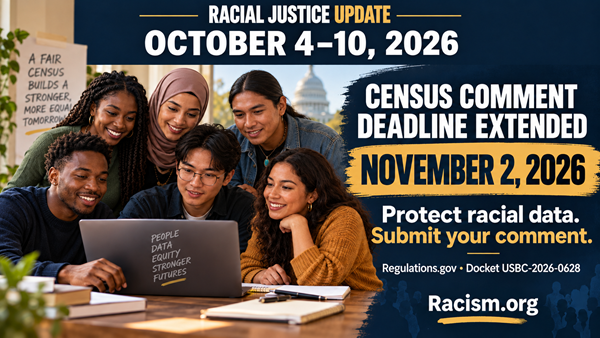
 Vernellia R. Randall, Weekly Racial Justice Update: October 4–10, 2026, Racism.org (October 11, 2026).
Racial justice requires more than promises of equal treatment. It requires the data to expose exclusion, the power to vote, and institutions that answer for the harm they cause. This week’s developments show those stakes in concrete terms: preserving census racial data, correcting voter-registration failures, confronting immigration-enforcement abuses, and defending Native families and tribal authority.
Communities are also building protection through litigation, voter assistance, historical memory, and organizing across racial lines. The Census comment deadline has been extended to November 2. Use the extended deadline to demand that the Census Bureau preserve the racial data our communities need to protect their rights and their children’s futures.
Table of Contents
- Census Comment Deadline Extended to November 2
- Advocates Defend Undocumented Students’ College Access
- Alaska Native Student Returns Home More Than a Century After Her Death at Carlisle
- Black Maternal Health Advocates Connect Pollution and Reproductive Justice
- Black Organizers Build Political Participation Beyond Election Day
- Black Women Describe the Lasting Harm of Federal Layoffs
- California Tribal Vetoes Expose Limits of an Apology
- Community Groups Address Language, ID, and Transportation Barriers
- Court Grants Preliminary Relief Against Immigration Fines
- Denaturalization Actions Put Citizenship Under Scrutiny
- Detroit Leaders Challenge Arab–Black Division
- Filipino American Students Sustain Cultural Belonging and Mutual Support
- Green-Card Sponsorship Suspension Threatens Immigrant Workers’ Futures
- Haverford Event Cancellation Draws Civil-Rights Objection
- ICE Shooting in New York Demands Independent Review
- Investigation Documents Detention of U.S. Citizens
- Jackson State Students Rally for Black Youth and Answers in Nolan Wells’s Death
- Japanese Americans Mobilize Against Immigrant Detention
- Minnesota Community Coalition Presses Businesses to Defend Elections
- NAACP Demands Transparency and Builds Election Protection
- Native Vote Week Documents Persistent Exclusion
- Samoan Survivor Promotes Community Cancer Awareness
- Senegalese HBCU Athlete Released After Two Months
- Supreme Court Declines Another ICWA Challenge
- Texas Registration Failures Threaten Eligible Voters
- Tribal Coalition Challenges Prediction-Market Sports Betting
- Overall Bottom Line
- Research Note
1. Census Comment Deadline Extended to November 2
The Census Bureau’s October 5 notice extends the public-comment deadline from October 13 to November 2. The underlying proposal would prohibit race and ethnicity questions on the decennial census questionnaires it covers; the American Community Survey and administrative data are excluded from that prohibition. Native America Calling’s October 6 discussion examined the consequences for Native communities.
Submit a Comment: Submit your comment on the proposed Census rule at Regulations.gov by November 2, 2026. If the form does not open, visit Docket USBC-2026-0628 and select the proposed rule’s Comment button.
Why It Matters: Black, Latino, Asian, Indigenous, and other communities need reliable population data to document exclusion and defend representation. For Tribal Nations, the stakes also include federal obligations and resources reaching their citizens.
Bottom Line: Use the additional time to submit comments and mobilize others. The extension changes the deadline; it does not remove the threat to racial data.
Sources:
- Census Bureau, Extension of Comment Period (October 5, 2026) (Last Visited: October 11, 2026).
- Census Bureau, Proposed Residence Criteria and Demographic Regulations (September 10, 2026) (Last Visited: October 11, 2026).
- Indianz.com / Native America Calling, What Removing Questions About Race from the U.S. Census Means for Native Americans (October 6, 2026) (Last Visited: October 11, 2026).
- Vernellia R. Randall, A Colorblind Census in a Racist Society: We Cannot Eliminate Racial Disparities by Refusing to Count Them, Racism.org (September 14, 2026) (Last Visited: October 12, 2026).
2. Advocates Defend Undocumented Students’ College Access
On October 7, TheDream.US, MALDEF, and the Presidents’ Alliance released a report on federal challenges to tuition-equity policies. On October 8, LatinoJustice PRLDEF and partners announced a friend-of-the-court brief defending New York’s laws in federal court. The brief argues for state authority and affordable education; it is not a court ruling.
Why It Matters: Removing resident tuition access places college further out of reach for undocumented students, including Latino students raised in the communities where they seek to study and work.
Bottom Line: Defend affordable education and track the actual effect of each lawsuit on students’ enrollment and degree completion.
Sources:
- Presidents’ Alliance, MALDEF, and TheDream.US, Federal Attacks on Dreamers’ Access to Tuition Equity (October 7, 2026) (Last Visited: October 11, 2026).
- LatinoJustice PRLDEF, Organizations Defend New York Tuition Laws for Undocumented Students (October 8, 2026) (Last Visited: October 11, 2026).
3. Alaska Native Student Returns Home More Than a Century After Her Death at Carlisle
ICT reports that Tummassak’s remains were reburied in Shishmaref on October 4, more than a century after she died at the Carlisle Indian Industrial School. The October 9 account follows her family’s work to identify her and bring her home.
Why It Matters: Boarding-school harm continues in families’ searches for relatives and communities’ efforts to restore them to their homelands. Repatriation restores a connection that government assimilation policies sought to sever.
Bottom Line: Support family-led repatriation, accurate identification, and accountability for the institutions responsible.
Sources:
- ICT, Forgotten No More: Alaska Community Embraces Long-Lost Student’s Return (October 9, 2026) (Last Visited: October 11, 2026).
4. Black Maternal Health Advocates Connect Pollution and Reproductive Justice
Human Rights Watch’s October 8 report describes the October 2 Black Birth Matters conference in Louisiana. Advocates, including RISE St. James’s Shamell Lavigne, examined petrochemical pollution, reproductive health, and preparedness for climate disasters. The conference occurred before this coverage week; the report was published during it.
Why It Matters: For Black mothers in industrial communities, pregnancy care and environmental protection are connected. Addressing medical access while ignoring the conditions where families live leaves an essential part of reproductive justice unresolved.
Bottom Line: Put pollution prevention, reproductive care, and community-led disaster planning into the same maternal-health agenda.
Sources:
- Human Rights Watch, Louisiana Activists Draw Links Between Petrochemical, Climate Harm to Maternal Health (October 8, 2026) (Last Visited: October 11, 2026).
5. Black Organizers Build Political Participation Beyond Election Day
Capital B’s October 9 reporting examines efforts by Hip Hop Caucus and other Black organizers to connect younger voters with economic concerns and participation beyond casting a ballot. Organizers emphasize involvement in campaigns and public decisions throughout the year. The report describes ongoing organizing.
Why It Matters: Black political power depends on opportunities to shape policy between elections. Organizing around the pressures younger Black people face can connect voting with decisions about jobs, public spending, and community conditions.
Bottom Line: Treat turnout as one part of sustained community participation; give young Black residents concrete opportunities to influence policy.
Sources:
- Capital B Gary, Black Organizers Change Their Message to the Hip-Hop Generation (October 9, 2026) (Last Visited: October 11, 2026).
6. Black Women Describe the Lasting Harm of Federal Layoffs
October 7–8 installments of a MindSite News series, published with Capital B and other partners, describe Black women’s financial strain, depression, anxiety, shame, and disrupted careers after federal layoffs in 2025. This is new reporting on continuing harm, not a new round of layoffs this week. The interviews document experiences; they are not a population-wide clinical survey.
Why It Matters: For the women interviewed, job loss also meant threatened family stability, lost professional identity, and difficulty rebuilding income. Treating these consequences as personal failure hides the government decisions that produced them.
Bottom Line: Accountability must include employment recovery, timely benefits, and accessible mental-health support for affected Black women.
Sources:
- Capital B / MindSite News, The Unseen Toll: Depression, Anxiety Plague Black Women a Year After DOGE Layoffs (October 7, 2026) (Last Visited: October 11, 2026).
- Capital B / MindSite News, A ‘Gut Punch’: Black Women Fired by DOGE Work to Overcome Shame and Self-Blame (October 8, 2026; updated October 9) (Last Visited: October 11, 2026).
7. California Tribal Vetoes Expose Limits of an Apology
October 8 ICT/CalMatters reporting examines Governor Newsom’s earlier vetoes of AB 2218, addressing tribal water inequities, and AB 1881, protecting tribal religious practices and sacred sites on state land. The vetoes followed his September 25 signing of legislation formalizing an apology to Native peoples. These were September actions receiving scrutiny this week.
Why It Matters: An apology does not provide tribes with enforceable authority over water and sacred places. The Karuk Tribe and Shingle Springs Band of Miwok Indians supported the water legislation because decisions affect their ancestral territories.
Bottom Line: Measure reconciliation by enforceable protections and tribal decision-making power.
Sources:
- ICT / CalMatters, Newsom Apologized to Tribes but Vetoed Two Bills That Would Have Empowered Them (October 8, 2026) (Last Visited: October 11, 2026).
- California Governor, AB 2218 Veto Message (September 2026) (Last Visited: October 11, 2026).
8. Community Groups Address Language, ID, and Transportation Barriers
October 10 reporting by AsAmNews, carrying American Community Media coverage, describes assistance with voter identification, registration, language access, and transportation. It highlights Asian Americans Advancing Justice’s multilingual assistance, Mi Familia Vota’s work with Texas voters, and Native American Rights Fund concerns about long travel distances. The reporting includes earlier developments and a September briefing.
Why It Matters: A formal right to vote means little when language barriers, document costs, and inaccessible polling places prevent people from using it. Asian, Latino, and Native communities face different barriers that require specific solutions.
Bottom Line: Make election access practical: language assistance, accurate registration guidance, affordable identification, and reachable polling places.
Sources:
- AsAmNews / American Community Media, As Midterms Near, Rights Groups Help Voters Navigate Voting Barriers (October 10, 2026) (Last Visited: October 11, 2026).
9. Court Grants Preliminary Relief Against Immigration Fines
Public Justice’s October 6 announcement highlights a September 30 ruling in Maria L. v. Mullin. The district court granted a stay under the Administrative Procedure Act after finding the requirements for preliminary relief satisfied. The case concerns civil penalties that can reach $998 per day. The ruling is preliminary, and the underlying opinion predates this coverage week.
Why It Matters: Enormous penalties threaten immigrants’ wages, homes, and family stability while they pursue available relief. Individual circumstances and a meaningful opportunity to challenge government action matter before financial punishment destroys a household.
Bottom Line: Immigrant families need protection from penalties that threaten their wages, homes, and ability to pursue legal relief. This preliminary ruling provides protection while the case continues.
Sources:
- U.S. District Court, District of Massachusetts, Maria L. v. Mullin, Opinion and Order, No. 25-13471-GAO (September 30, 2026) (Last Visited: October 11, 2026).
- Public Justice, Federal Court Blocks Civil Penalty Scheme Targeting Immigrant Families (October 6, 2026) (Last Visited: October 11, 2026).
10. Denaturalization Actions Put Citizenship Under Scrutiny
DOJ announced October 5 that it had filed denaturalization actions against 40 people. AsAmNews reports that 12 are Asian Americans, including Chinese, Pakistani, Filipino, Indian, and Cambodian Americans. These are lawsuits seeking revocation, not proof that all 40 have lost citizenship. DOJ alleges unlawful procurement or concealment in the individual cases.
Why It Matters: Naturalized communities need clear, individualized standards and fair proceedings. Public accusations must not turn into collective suspicion of Asian Americans or other immigrant communities.
Bottom Line: Naturalized citizens deserve individualized evidence and fair proceedings. Allegations against particular people must not become a license to question entire communities’ citizenship.
Sources:
- Department of Justice, Announcement of 40 Denaturalization Actions (October 5, 2026) (Last Visited: October 11, 2026).
- AsAmNews, DOJ Trying to Strip Citizenship from 12 Asian Americans (October 6, 2026) (Last Visited: October 11, 2026).
11. Detroit Leaders Challenge Arab–Black Division
The Arab American News’s October 9 account describes community leaders’ criticism of coverage following a September incident involving abuse directed at Black driver Susan Glass-Smith. Leaders warned against collective blame and inflammatory framing. Their allegations of coordinated media motives are not independently established by this review.
Why It Matters: Solidarity requires confronting anti-Black mistreatment while rejecting anti-Arab and anti-Muslim stereotyping. Protecting a coalition cannot require minimizing the harm to a Black woman.
Bottom Line: Demand accountability for individual conduct and reporting that informs communities without assigning collective guilt.
Sources:
- The Arab American News, Detroit Leaders Condemn Warrendale Incident Coverage, Warn Against Arab–Black Division (October 9, 2026) (Last Visited: October 11, 2026).
12. Filipino American Students Sustain Cultural Belonging and Mutual Support
Northwest Asian Weekly’s October 6 profile describes the University of Washington’s Filipino American Student Association and its October cultural workshops, including dance and Baybayin writing sessions. The association also supports students through community service, political work, and academic activities. The profile covers ongoing work and October programming.
Why It Matters: Cultural preservation and student support are part of racial justice. Filipino American students’ own institutions help sustain belonging, cultural knowledge, and opportunities to organize in university settings.
Bottom Line: Filipino American students’ work to preserve their culture and support one another deserves recognition as part of racial justice. Their communities must have room to build and sustain their own institutions.
Sources:
- Northwest Asian Weekly, Filipino American Student Association Provides ‘Home Away from Home’ at UW: Community Rooted in 109-Year History (October 6, 2026) (Last Visited: October 11, 2026).
13. Green-Card Sponsorship Suspension Threatens Immigrant Workers’ Futures
On October 8, the administration announced a suspension of new and pending PERM labor-certification applications involving Microsoft, Adobe, and six IT firms. PERM is a step in many employer-sponsored green-card cases; this announcement should not be described as a blanket cancellation of existing H-1B visas. Officials alleged employer abuse. Microsoft disputed the portrayal of its hiring practices, and Representative Pramila Jayapal criticized the restriction on legal immigration.
Why It Matters: Immigrant workers and their families face uncertainty when employer investigations interrupt a path to permanent residence. Asian and South Asian tech communities have a direct stake in fair enforcement that addresses employer conduct without treating foreign-born workers as disposable.
Bottom Line: Protect U.S. and immigrant workers from employer abuse while preserving fair, clearly explained pathways to permanent residence.
Sources:
- Reuters, Trump Administration Freezes Green Cards for Microsoft, IT Firms, Probes Universities (October 8, 2026; updated October 9) (Last Visited: October 12, 2026).
- Factbase / Roll Call, Press Conference: JD Vance Discusses Efforts to Reduce Visa Fraud (October 8, 2026) (Last Visited: October 12, 2026).
- Representative Pramila Jayapal, Statement on Trump Suspending Microsoft from the PERM Program (October 8, 2026) (Last Visited: October 12, 2026).
14. Haverford Event Cancellation Draws Civil-Rights Objection
CAIR-Philadelphia’s statement, dated October 8 and posted October 9, criticizes Haverford’s cancellation of an October 7 Palestinian-solidarity art event. According to CAIR, the president cited timing and safety risks despite acknowledging that the event complied with college policy. CAIR says it is considering contract-based legal action. No court finding of discrimination is established here.
Why It Matters: Palestinian, Arab, Muslim, and allied students need consistent rules for campus expression. Safety explanations must be specific enough to assess whether restrictions are applied fairly.
Bottom Line: Palestinian, Arab, and Muslim students deserve consistent protection for campus expression. Haverford must explain the cancellation and whether it applies the same standards to other events.
Sources:
- CAIR-Philadelphia, Cancellation of Palestine Solidarity Event (October 8, 2026; posted October 9) (Last Visited: October 11, 2026).
15. ICE Shooting in New York Demands Independent Review
An ICE officer shot and wounded Oscar Belgal on October 8 while a five-year-old child was in his car. He survived. Federal officials defended the shooting and alleged that he used the vehicle against officers; the incident remains contested. Neither allegations about his past nor the agency’s account settle whether the shooting was justified.
Why It Matters: The safety of a Dominican man and a child must remain central. Immigration enforcement requires accountability for the force used against people, regardless of accusations about their immigration status or criminal history.
Bottom Line: Preserve the evidence, investigate independently, and require a full account of the shooting and medical care.
Sources:
- Associated Press, ICE Officer Shoots a Man While Making an Arrest in New York (October 8, 2026) (Last Visited: October 11, 2026).
- Reuters, U.S. Immigration Chiefs Defend Shooting of New York Man, Attack ‘Sanctuary’ Policies (October 9, 2026; updated October 10) (Last Visited: October 11, 2026).
16. Investigation Documents Detention of U.S. Citizens
An October 6 ProPublica investigation documents more than 500 U.S. citizens detained during immigration enforcement. Its count focuses on warrantless arrests away from airports and borders and excludes arrests under judicial warrants. The database covers incidents over time, not 500 detentions during this week.
Why It Matters: U.S. citizens must not lose their freedom because officers associate their appearance, accent, or community with undocumented immigration. The investigation demands scrutiny of racial profiling and the safeguards against wrongful detention.
Bottom Line: Require documented grounds for stops, prompt identity checks, and accountability for wrongful detention.
Sources:
- ProPublica, More Than 500 U.S. Citizens Have Been Detained in Trump’s Immigration Crackdown (October 6, 2026) (Last Visited: October 11, 2026).
17. Jackson State Students Rally for Black Youth and Answers in Nolan Wells’s Death
Jackson State students held an October 7 Blackout Rally honoring young Black people who died, including Nolan Wells. On October 5, Wells’s family and advocates renewed calls for federal investigation. State and private autopsies classified his cause and manner of death as undetermined; a September grand jury found no basis for criminal charges. Those findings do not establish that his death was a homicide or a racial attack.
Why It Matters: Black students are demanding that young Black lives receive serious attention and that families receive credible answers. Support for Wells, who was Black and Filipino American, also connects Black and Asian American advocacy.
Bottom Line: Support students’ organizing and the family’s demand for a thorough, transparent review. Accountability requires evidence, and unproven accusations must not replace it.
Sources:
- WLBT, Jackson State Students March in Blackout Rally for Black Youth (October 7, 2026) (Last Visited: October 12, 2026).
- ABC News, Family of Nolan Wells Calls for Federal Probe into His Death After Grand Jury Says No Criminal Charges (October 5, 2026) (Last Visited: October 12, 2026).
18. Japanese Americans Mobilize Against Immigrant Detention
October 10 AsAmNews reporting describes a four-day, approximately 48-mile pilgrimage from Seattle to Tacoma organized by Tsuru for Solidarity. Japanese American incarceration survivors and descendants connect their community’s history to present-day immigrant detention.
Why It Matters: This organizing turns historical memory into solidarity with people facing confinement and family separation. It challenges the idea that injustice against one racial community is someone else’s concern.
Bottom Line: Support coalitions that use the experience of past racial injustice to confront current government harm.
Sources:
- AsAmNews, Japanese Americans Walk 48 Miles to Support ICE Detainees (October 10, 2026) (Last Visited: October 11, 2026).
19. Minnesota Community Coalition Presses Businesses to Defend Elections
Minnesota Women’s Press reports that an October 5 news conference pressed major corporations to support election integrity. Community organizers, including Unidos MN representatives, asked businesses to respond by October 19. The October 6 report, updated October 9, also describes transportation, voter education, and legal preparation. Organizers’ contingency scenarios are preparations, not findings that those disruptions have occurred.
Why It Matters: Immigrant communities and other residents facing intimidation need local networks that make participation practical and safe. Latino organizing through Unidos MN connects those protections with demands that employers defend their employees’ and customers’ voting rights.
Bottom Line: Community election protection includes rides, trusted information, legal support, and public commitments from businesses.
Sources:
- Minnesota Women’s Press, Protecting Democracy #2: How Community and Media Are Working to Support Election Integrity (October 6, 2026; updated October 9) (Last Visited: October 11, 2026).
20. NAACP Demands Transparency and Builds Election Protection
The NAACP’s October 5 announcement describes its lawsuit and request for emergency disclosure of Justice Department election-monitoring records. On October 8, it announced plans for a legal War Room by October 24 to respond to credible reports of intimidation and voting problems. These are requests and preparations, not findings that every monitor will intimidate voters.
Why It Matters: Black voters should not have to choose between exercising political power and facing unexplained government scrutiny. Knowing monitors’ authority, training, and assignments helps communities distinguish lawful oversight from interference.
Bottom Line: Black voters need clear limits on election monitors’ authority and a rapid response when intimidation threatens their right to vote.
Sources:
- NAACP, Emergency Lawsuit to Secure Election-Monitoring Records (October 5, 2026) (Last Visited: October 11, 2026).
- NAACP, Plans for Midterm War Room (October 8, 2026) (Last Visited: October 11, 2026).
- Word In Black, The Election Watchers Are Coming. Who’s Watching Them? (October 8, 2026) (Last Visited: October 11, 2026).
21. Native Vote Week Documents Persistent Exclusion
NARF’s Native Vote Week, October 5–9, highlighted voting resources and a report using election-administration data from 2020, 2022, and 2024. NARF reports a 59 percent decline in new registrations in counties with large Native voter populations between 2020 and 2024, alongside increased provisional-ballot use. County-level findings do not identify every individual voter’s race.
Why It Matters: Native voting access requires more than turnout appeals. Registration systems, residential-address requirements, and polling access must work for reservation communities.
Bottom Line: Native voters need registration and polling systems that work for reservation communities. The reported disparities require investigation and corrective action.
Sources:
- Native American Rights Fund, Native Vote Week (October 4, 2026) (Last Visited: October 11, 2026).
22. Samoan Survivor Promotes Community Cancer Awareness
An October 7 Northwest Asian Weekly profile highlights Samoan resident Johnathan Tuiasosopo’s outreach about prostate cancer after his own treatment. He and his physician discuss awareness and conversations about screening, while Tuiasosopo describes his efforts to reach local Samoan families. This is new reporting on ongoing outreach; a baseball-related screening event described in the article occurred in June.
Why It Matters: Community messengers can help Pacific Islander families discuss health concerns and connect with care. Coverage that identifies Samoan experiences also prevents Pacific Islander health needs from disappearing within broad Asian American categories.
Bottom Line: Pacific Islander families need culturally grounded health information and accessible care. Trusted Samoan community voices help make those connections.
Sources:
- Northwest Asian Weekly, Samoan Prostate Cancer Survivor and His Doctor Urge Pacific Islanders to Get Screened (October 7, 2026) (Last Visited: October 11, 2026).
23. Senegalese HBCU Athlete Released After Two Months
Capital B reports that Kentucky State University graduate student and basketball player Aminata Seck was released October 7 after two months in ICE custody. Her attorney described isolation and inconsistent treatment for injuries. ICE stated that it provides medical care but did not resolve the specific concerns reported by her legal team.
Why It Matters: A Black international student’s detention disrupted her education and access to needed treatment. Her release does not erase the harm or answer questions about detention conditions.
Bottom Line: Protect her access to education and care, and investigate the treatment her attorneys describe.
Sources:
- Capital B, Kentucky State Basketball Player Released After Two Months in Detention (October 9, 2026) (Last Visited: October 11, 2026).
24. Supreme Court Declines Another ICWA Challenge
On October 5, the Supreme Court denied review in N.R. v. Ellison, leaving Minnesota decisions in place in a dispute involving Red Lake Nation children. NARF explains that the former foster parents challenged the Indian Child Welfare Act and Minnesota’s Indian-family protections. Denial of review is not a new Supreme Court decision on the merits of those constitutional arguments.
Why It Matters: The result preserves the lower-court outcome and the protections at issue for Native children’s family and tribal connections. Tribal citizenship and sovereignty must not be reduced to a claim that Native families are receiving an improper racial preference.
Bottom Line: Native children’s family and tribal connections remain protected by the lower-court outcome. Defending those connections is essential to tribal sovereignty and the survival of Native communities.
Sources:
- U.S. Supreme Court, Order List: N.R. v. Ellison, No. 25-1287 (October 5, 2026) (Last Visited: October 11, 2026).
- Native American Rights Fund, Supreme Court Rejects Challenge to Indian Child Welfare Act (October 5, 2026) (Last Visited: October 11, 2026).
25. Texas Registration Failures Threaten Eligible Voters
An October 8 NAACP statement says programming failures delayed more than 500,000 voter registrations and updates submitted through Texas’s Department of Public Safety. The NAACP, its Texas conference, and Texas LULAC demanded corrective action through a notice from the Southern Poverty Law Center. That figure counts registrations and updates; it does not establish that 500,000 separate voters lost their vote.
Why It Matters: Black and Latino voters who followed the registration process must not bear the cost of the state’s failures. Fixing the software does not restore their voting rights unless their registrations are accurate and they can cast a ballot.
Bottom Line: Require proof that each affected eligible voter is properly registered and notified before voting.
Sources:
- NAACP, Voting Rights Groups Demand Texas Correct Motor Voter Registration Failures (October 8, 2026) (Last Visited: October 11, 2026).
26. Tribal Coalition Challenges Prediction-Market Sports Betting
NARF announced October 8 that more than 140 Tribal Nations and tribal organizations filed a brief asking the Supreme Court to take up Flaherty v. KalshiEX. They argue that sports-event contracts evade gaming laws and operate on Indian lands without tribal authorization. These are the coalition’s legal arguments, not a final Supreme Court ruling.
Why It Matters: The dispute concerns tribes’ authority to regulate activity on their lands and protect the revenue supporting self-government. Calling a product a financial contract does not answer the sovereignty question.
Bottom Line: Tribal Nations must have the authority to regulate gaming on their lands and protect the revenues that support their communities. A financial label must not become a route around tribal sovereignty.
Sources:
- Native American Rights Fund, Tribal Nations Urge Supreme Court to Stop Prediction-Market Gaming (October 8, 2026) (Last Visited: October 11, 2026).
Overall Bottom Line
Racial justice requires institutions to answer for their decisions and the harm those decisions cause. Black and Latino voters need registration systems that work. Immigrants and naturalized citizens need fair proceedings and protection from unjustified force. Black women need support to rebuild after government-driven job loss. Native communities need enforceable authority over their children, lands, water, and resources.
Communities are also building political power, preserving culture, and connecting families with care. That work belongs in the racial-justice story. Preserve racial data, defend political participation, and demand protections that communities can use and enforce.
Research Note
This update covers October 4–10, 2026, using government and court records, credible journalism, civil-rights organizations, and media serving communities of color. Sources were reviewed October 11–12; earlier events receiving new coverage are identified, and allegations are distinguished from established findings. ChatGPT assisted with research and drafting; Vernellia R. Randall retains final editorial responsibility.
Vernellia R. Randall, Professor Emerita of Law, University of Dayton School of Law. This article is the sole intellectual and scholarly work of Vernellia Randall. ChatGPT was used only as a drafting aid comparable to a research or editing assistant. All concepts, analysis, legal reasoning, interpretations, and conclusions are entirely the author’s own, and the author assumes full responsibility for the content.