
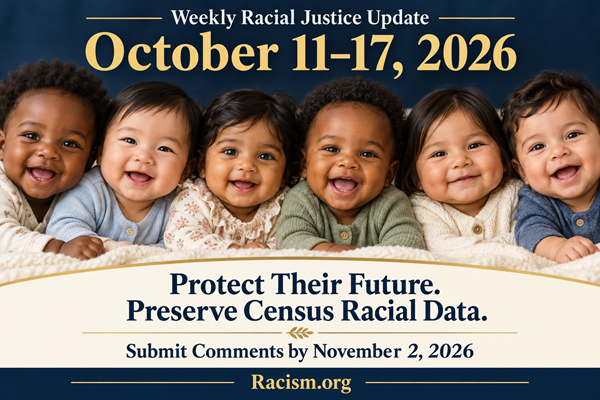
Vernellia R. Randall, Weekly Racial Justice Update: October 11–17, 2026, Racism.org (October 18, 2026).
Racial justice depends on whether people can exercise their rights in daily life: cast a ballot without intimidation, attend college without repeated disruptions, remain in their homes, worship safely, and obtain the records needed to hold government accountable. This week brought challenges to federal election interventions, evidence of substantial funding losses in Indian Country, and demands to protect historical records documenting racial exclusion and federal obligations.
Communities are also organizing their responses. Black civic organizations are expanding voter outreach, immigrant-rights advocates are challenging dangerous detention conditions and accelerated proceedings against children, and Indigenous educators are creating pathways to restore Native languages. The Census comment deadline remains November 2, 2026. Use that opportunity to defend the racial data communities need to expose discrimination and protect their futures.
Table of Contents
- Census Comments Remain Open Through November 2
- Alaska Native Language Educators Gain a New Certification Pathway
- Alleged Hindu Temple Shooting Plot Raises Community Safety Concerns
- Archives Closures Threaten Access to Evidence of Racial Injustice
- Atlanta’s Eviction Crisis Falls Disproportionately on Black Renters
- Black Organizations Announce National Black Man Voter Day
- California Ballot Challenges Draw Emergency Litigation
- Civil-Rights and Privacy Groups Challenge Federal Voter Database
- Detained Immigrants Seek Emergency Protection at Camp East Montana
- Dismissal Ends One Challenge to Small-Business Opportunity Program
- Federal Contractor Ruling Clarifies Limits of Anti-DEI Order
- Hate-Crime Charges Follow Alleged Threats Against Muslim Women
- Lawsuit Challenges Accelerated Asylum Proceedings for Unaccompanied Children
- NAACP Challenges Federal Law Enforcement at Polling Sites
- Native Hawaiian Leaders Defend Programs Addressing Historical Injustice
- New Analysis Documents Nearly $470 Million in Native Funding Losses
- New Report Connects Anti-Asian Hate and Anti-Immigrant Hostility
- North Carolina Communities Organize Against Expanded Immigration Detention
- Organizers Reach Black Voters Overlooked by Traditional Campaigns
- Southern University Students Confront Repeated Power Outages
- Tribal Advocates Warn About Threats to Klamath Salmon Restoration
- Bottom Line
- Search Note
1. Census Comments Remain Open Through November 2
Continuing action opportunity: The Census Bureau’s October 5 notice extended the comment deadline to November 2, 2026. The underlying proposal concerns residence criteria and demographic questions, including removing race and ethnicity questions from the decennial census questionnaire. Comments should identify Docket USBC-2026-0628.
Why It Matters: Black, Latino, Indigenous, Asian American, Native Hawaiian, and Pacific Islander communities need reliable racial data to expose disparities and support civil-rights enforcement. Removing these questions would weaken an essential source of information about who lives in this country and how communities are treated.
Bottom Line: Submit comments opposing the removal of race and ethnicity questions. Explain how your community uses census data to protect voting rights, health, education, housing, and equal opportunity.
Sources:
Census Bureau, “Decennial Census of the Population of Americans; Proposed Residence Criteria and Proposed Regulations for Demographic Questions,” September 10, 2026.
https://www.govinfo.gov/content/pkg/FR-2026-09-10/html/2026-18481.htm
Last visited: October 18, 2026.
Census Bureau, “Decennial Census of the Population of Americans; Proposed Residence Criteria and Proposed Regulations for Demographic Questions; Extension of Comment Period,” October 5, 2026.
https://www.govinfo.gov/content/pkg/FR-2026-10-05/html/2026-20328.htm
Last visited: October 18, 2026.
2. Alaska Native Language Educators Gain a New Certification Pathway
October 16 reporting highlights the University of Alaska Southeast’s new Master of Arts in Teaching Indigenous Languages program. The university announced in September that classes were underway for its inaugural cohort. The program provides a pathway for Indigenous-language speakers to become fully licensed teachers, addressing limitations associated with restricted teaching certificates.
Why It Matters: Government-supported suppression of Native languages damaged cultural transmission across generations. Recognizing Indigenous-language expertise through full professional credentials supports language restoration and fair treatment of the educators carrying that work.
Bottom Line: Language revitalization requires paid, professionally supported teaching positions and educational systems that recognize Alaska Native knowledge.
Sources:
Native News Online, “New Teaching Certification Opens Doors for Indigenous Language Educators in Alaska,” October 16, 2026.
https://nativenewsonline.net/education/new-teaching-certification-opens-doors-for-indigenous-language-educators-in-alaska/
Last visited: October 18, 2026.
University of Alaska Southeast, “UAS Launches Alaska’s First Licensure Program for Teaching Indigenous Languages,” September 16, 2026.
https://uas.alaska.edu/about/press-releases/2026/091626-matil.html
Last visited: October 18, 2026.
3. Alleged Hindu Temple Shooting Plot Raises Community Safety Concerns
October 15–16 reporting describes the arrest of a man accused of planning a mass shooting potentially targeting a Hindu place of worship in Aurora, Illinois. Police reported recovering weapons and a document expressing white-supremacist views. Reuters reported that police had not yet confirmed the specific intended location. The criminal allegations remain subject to court proceedings.
Why It Matters: Threats against Hindu worshippers endanger South Asian communities’ safety and religious freedom. Anti-Indian racism and religious hatred can reinforce one another while spreading fear beyond the immediate target.
Bottom Line: Protect Hindu communities’ ability to worship safely, investigate the alleged plot thoroughly, and address the white-supremacist hostility described in the reporting.
Sources:
AsAmNews, “White Supremacist’s Manifesto Found in Hindu Temple Shooting Plot,” October 16, 2026.
https://asamnews.com/2026/10/16/aurora-hindu-temple-shooting-plot-manifesto-court-documents/
Last visited: October 18, 2026.
Reuters, “Police Say Chicago Suburb Suspect in Alleged Mass Shooting Plot Had White Supremacy Manifesto,” October 15, 2026.
https://www.reuters.com/legal/government/police-say-chicago-suburb-suspect-alleged-mass-shooting-plot-had-white-supremacy-2026-10-15/
Last visited: October 18, 2026.
4. Archives Closures Threaten Access to Evidence of Racial Injustice
California sued October 14 to block the closure of the National Archives facility in San Bruno and transfer of its holdings. Separately, four Native organizations requested meaningful tribal consultation concerning planned closures in San Bruno and Chicago. The collections include records concerning immigration, exclusion, boarding schools, land, and federal dealings with Tribal Nations.
Why It Matters: Chinese American and Japanese American families, boarding-school survivors’ descendants, and Tribal Nations rely on these records to recover family histories and document government conduct. Moving records away from affected communities creates barriers to historical knowledge and legal accountability.
Bottom Line: Preserve meaningful access to these records and require affected communities to have a voice in decisions about their future.
Sources:
California Department of Justice, “Attorney General Bonta Sues to Block Closure of San Francisco National Archives,” October 14, 2026. Includes the complaint.
https://www.oag.ca.gov/news/press-releases/attorney-general-bonta-sues-block-closure-san-francisco-national-archives
Last visited: October 18, 2026.
Native News Online, “Native Organizations Demand Tribal Consultation Over Planned National Archives Closures,” October 16, 2026.
https://nativenewsonline.net/currents/native-organizations-demand-tribal-consultation-over-planned-national-archives-closures/
Last visited: October 18, 2026.
5. Atlanta’s Eviction Crisis Falls Disproportionately on Black Renters
Capital B Atlanta’s October 14 reporting examines gubernatorial candidates’ responses to the region’s eviction crisis. It reports that Black renters account for roughly 70 percent of eviction cases in five metropolitan counties while representing approximately 52 percent of renters. Eviction filings are legal actions; they should not be treated as a count of completed removals or unique displaced households.
Why It Matters: The disparity places Black families at heightened risk of housing instability, disrupted schooling, financial loss, and declining health. General promises about affordability require scrutiny for whether they prevent eviction among those most affected.
Bottom Line: Judge housing proposals by their ability to keep Black families housed through enforceable protections, legal assistance, and effective eviction prevention.
Source:
Capital B Atlanta, “How Georgia’s Gubernatorial Candidates Plan to Fight Atlanta’s Eviction Crisis,” October 14, 2026.
https://atlanta.capitalbnews.org/bottoms-jackson-atlanta-eviction-crisis/
Last visited: October 18, 2026.
6. Black Organizations Announce National Black Man Voter Day
An October 16 announcement sets out a nonpartisan Week of Action for October 19–24, culminating in National Black Man Voter Day on October 24. Organizers plan voter education, community conversations, transportation coordination, and group voting where early voting is available. The stated goal of mobilizing 100,000 Black men is a target, not an achieved participation count.
Why It Matters: Black men’s political participation requires sustained investment in community leadership and practical access. Transportation, reliable information, and trusted relationships help turn political concerns into collective power.
Bottom Line: Support organizing that enables Black men to define their priorities, vote, and hold officials accountable beyond a single election.
Source:
NAACP, “National Black Man Voter Day Set for October 24th, Coalition Launches Week of Action,” October 16, 2026.
https://naacp.org/articles/national-black-man-voter-day-set-october-24th-coalition-launches-week-action
Last visited: October 18, 2026.
7. California Ballot Challenges Draw Emergency Litigation
On October 15, CHIRLA and the UCLA Voting Rights Project sought emergency protection against federal efforts to withhold or segregate ballots belonging to people identified as alleged noncitizens. On October 16, the NAACP and LULAC sought to intervene in a related Justice Department lawsuit. Their announcement describes more than 20,000 Los Angeles County voters as potentially affected. These filings seek protection; they do not establish that the challenged voters are ineligible or that the courts have granted the requested relief.
Why It Matters: Naturalized citizens must not lose their votes because government databases fail to reflect their citizenship accurately. Latino and other immigrant communities face particular risks when allegations of noncitizenship substitute for reliable evidence and a meaningful opportunity to respond.
Bottom Line: Protect eligible voters from ballot exclusion based on undisclosed or inaccurate lists. Citizenship challenges require evidence, notice, and a fair opportunity to correct errors.
Sources:
NAACP, “NAACP Joins Pro-Voter Coalition to Intervene in DOJ Lawsuit to Protect California Voters Ahead of Midterms,” October 16, 2026. Includes the filed motion.
https://naacp.org/articles/naacp-joins-pro-voter-coalition-intervene-doj-lawsuit-protect-california-voters-ahead
Last visited: October 18, 2026.
UCLA Voting Rights Project, “CHIRLA and UCLA Voting Rights Project Ask Court to Stop Justice Department from Targeting California Voters,” October 15, 2026. Includes the emergency application.
https://vrp.ucla.edu/chirla-and-ucla-voting-rights-project-ask-court-to-stop-justice-department-from-segregating-california-ballots/
Last visited: October 18, 2026.
8. Civil-Rights and Privacy Groups Challenge Federal Voter Database
The League of Women Voters, Electronic Privacy Information Center, and LULAC filed suit October 15 challenging the Department of Homeland Security’s collection and use of voter records. The complaint alleges that DHS obtained files from at least 47 states and combined voter information with commercial data without required legal safeguards. The plaintiffs seek to stop the challenged practices. The alleged violations have not been resolved by a final judgment.
Why It Matters: Connecting voter registration records to immigration enforcement puts Latino voters, naturalized citizens, and others wrongly labeled noncitizens at risk of investigation and intimidation. Eligible voters should not have to fear government scrutiny because they exercise their right to vote.
Bottom Line: Stop unauthorized use of voter information and require accountability for inaccurate citizenship accusations that threaten eligible voters.
Source:
Democracy Forward, “Voting Rights and Privacy Organizations Sue Trump-Vance Administration Over Secretive Collection of Millions of Americans’ Voter Records,” October 15, 2026. Includes the filed complaint.
https://democracyforward.org/news/press-releases/voting-rights-and-privacy-organizations-sue-trump-vance-administration-over-secretive-collection-of-millions-of-americans-voter-records/
Last visited: October 18, 2026.
9. Detained Immigrants Seek Emergency Protection at Camp East Montana
An October 16 announcement describes a new preliminary-injunction request in the litigation over Camp East Montana at Fort Bliss, Texas. The filing seeks improvements in medical care and detention conditions. Supporting declarations describe inadequate food, medical neglect, unsafe conditions, and staff violence. KVIA reports that ICE and DHS have defended conditions at the facility. The lawsuit began in May; this week’s development is the request for immediate relief supported by additional evidence. The allegations remain before the court.
Why It Matters: When the government confines people, it assumes responsibility for their safety and medical care. Latino, Black, Asian, and other detained immigrants must not be subjected to neglect, hunger, or violence because the government controls their access to help.
Bottom Line: Demand immediate protection from dangerous conditions, necessary medical care, access to counsel, and independent investigation of the alleged abuse.
Sources:
American Civil Liberties Union, “Legal Organizations Urge Federal Court to End Abuse and Deadly Conditions and Protect People Detained at Camp East Montana,” October 16, 2026. Includes the injunction filing and supporting materials.
https://www.aclu.org/press-releases/legal-organizations-urge-federal-court-to-end-abuse-and-deadly-conditions-and-protect-people-detained-at-camp-east-montana
Last visited: October 18, 2026.
KVIA, “Camp East Montana Deaths Spark Urgent Federal Court Motion for Changes,” October 16, 2026.
https://kvia.com/news/border/2026/10/16/camp-east-montana-deaths-spark-urgent-federal-court-motion-for-changes/
Last visited: October 18, 2026.
10. Dismissal Ends One Challenge to Small-Business Opportunity Program
An October 15 order dismissed Revier Technologies, Inc. v. Loeffler following the parties’ stipulation. The litigation challenged aspects of the Small Business Administration’s 8(a) Business Development Program. Two businesses had intervened to defend the program. The dismissal was without prejudice and did not decide the merits of the constitutional arguments.
Why It Matters: Black and other historically excluded business owners continue to face barriers to federal contracts and business development. Attacks on programs addressing those barriers threaten access to public spending and opportunities to build community wealth.
Bottom Line: Defend meaningful access to federal contracting for historically excluded businesses. This dismissal ends one lawsuit; it does not end the attacks on these opportunities.
Sources:
Democracy Forward, “Legal Challenge to Protections and Opportunities for Historically Disadvantaged Entrepreneurs and Small Business Owners Is Dismissed,” October 15, 2026.
https://democracyforward.org/news/press-releases/legal-challenge-to-protections-and-opportunities-for-historically-disadvantaged-entrepreneurs-and-small-business-owners-is-dismissed/
Last visited: October 18, 2026.
U.S. District Court, Eastern District of Louisiana, Revier Technologies, Inc. v. Loeffler, No. 2:25-cv-02328, Order Dismissing Case Without Prejudice, October 15, 2026.
https://democracyforward.org/wp-content/uploads/2026/10/59-Order-Dismissing-Case-without-prejudice.pdf
Last visited: October 18, 2026.
11. Federal Contractor Ruling Clarifies Limits of Anti-DEI Order
On October 14, U.S. District Judge Adam Abelson denied a preliminary injunction and stay challenging the administration’s federal-contractor DEI order and its implementing memorandum. The court interpreted the order as prohibiting intentional race or ethnicity discrimination in work performed under the covered government contract. The decision does not declare all diversity initiatives unlawful or resolve every remaining claim.
Why It Matters: Black and other workers of color lose opportunities when employers use federal threats as a reason to abandon lawful efforts to remove discrimination. Treating every diversity initiative as unlawful helps preserve the barriers those initiatives were created to address.
Bottom Line: Preserve lawful equity work. Do not use this ruling as an excuse to dismantle programs that address racial exclusion.
Sources:
Democracy Forward, “Court Offers Clarity, Limiting Trump Executive Order and Administration’s Crusade Against Diversity, Equity, and Inclusion,” October 14, 2026.
https://democracyforward.org/news/press-releases/court-offers-clarity-limiting-trump-executive-order-and-administrations-crusade-against-diversity-equity-and-inclusion/
Last visited: October 18, 2026.
Reuters, “US Judge Won’t Block Trump Order Targeting DEI by Federal Contractors,” October 14, 2026.
https://www.reuters.com/legal/government/us-judge-wont-block-trump-order-targeting-dei-by-federal-contractors-2026-10-14/
Last visited: October 18, 2026.
U.S. District Court, District of Maryland, National Association of Diversity Officers in Higher Education v. Trump, No. 8:26-cv-01532, Memorandum Opinion, October 14, 2026.
https://docs.justia.com/cases/federal/district-courts/maryland/mddce/8:2026cv01532/603953/47
Last visited: October 18, 2026.
12. Hate-Crime Charges Follow Alleged Threats Against Muslim Women
CAIR-Chicago announced October 16 that a Des Plaines man faces felony hate-crime charges after allegedly threatening to shoot three Muslim women wearing hijabs at a public park. CAIR attributes details of the incident to police. Charges are allegations, not convictions; a directly accessible police account was not obtained for this item.
Why It Matters: Muslim women’s visible religious identity can expose them to racialized harassment and threats in ordinary public spaces. Such intimidation restricts freedom of movement, religious expression, and equal access to community life.
Bottom Line: Muslim women must be able to use public spaces safely. Authorities should investigate threats, support those targeted, and provide transparent information about the prosecution.
Source:
CAIR, “CAIR-Chicago Welcomes Hate Crime Charges for ‘White Power’ Threats Targeting Muslim Women at Des Plaines Park,” October 16, 2026.
https://www.cair.com/press_releases/cair-chicago-welcomes-hate-crime-charges-for-white-power-threats-targeting-muslim-women-at-des-plaines-park/
Last visited: October 18, 2026.
13. Lawsuit Challenges Accelerated Asylum Proceedings for Unaccompanied Children
On October 15, six legal-service organizations filed The Door v. Edlow in federal court in Maryland. The complaint challenges policies allegedly rushing unaccompanied children through asylum and immigration proceedings, including extremely short interview notices and a January 31, 2027 deadline for completing detained children’s cases. These are allegations in a newly filed lawsuit, not established judicial findings.
Why It Matters: A child cannot fairly present an asylum claim without time to prepare, language assistance, and meaningful access to counsel. Rushing Latino and other immigrant children through these proceedings puts their safety at risk and undermines the protections Congress established for them.
Bottom Line: Enforce the protections for unaccompanied children. Government deadlines must not deprive children of a meaningful opportunity to seek safety.
Sources:
National Center for Youth Law, “The Door v. Edlow,” October 15, 2026. Includes the filed complaint.
https://youthlaw.org/cases/the-door-v-edlow/
Last visited: October 18, 2026.
National Immigration Law Center, “Advocates for Unaccompanied Children File Lawsuit to Stop Federal Government’s Fast-Track Deportation Scheme,” October 15, 2026.
https://www.nilc.org/press/advocates-unaccompanied-children-file-lawsuit-stop-federal-governments-fast-track-deportation-scheme/
Last visited: October 18, 2026.
14. NAACP Challenges Federal Law Enforcement at Polling Sites
The NAACP and Advancement Project filed suit October 16 challenging the Justice Department’s deployment of federal prosecutors and other federal law-enforcement personnel through its election-monitoring program. The plaintiffs argue that the challenged practices threaten intimidation and interfere with election administration. Their allegations have not been established by a final judgment.
Why It Matters: Black communities have a long history of encountering law enforcement as an instrument of voter suppression. Election protection requires clear limits that prevent federal authority from discouraging the very voters civil-rights laws are supposed to protect.
Bottom Line: Federal election oversight must protect Black and other targeted voters from intimidation. Its personnel, authority, and conduct must remain subject to public scrutiny and legal limits.
Source:
NAACP, “The NAACP and Advancement Project Sue to Block DOJ Plans to Deploy Federal Law Enforcement As ‘Election Monitors,’” October 16, 2026. Includes the complaint.
https://naacp.org/articles/naacp-and-advancement-project-sue-block-doj-plans-deploy-federal-law-enforcement-election
Last visited: October 18, 2026.
15. Native Hawaiian Leaders Defend Programs Addressing Historical Injustice
October 15 reporting describes a legislative briefing about legal challenges to Native Hawaiian education, housing, and health programs. Speakers emphasized the overthrow of the Hawaiian Kingdom, land dispossession, and the distinct historical and legal foundations of these programs. This was a discussion of ongoing litigation and policy threats, not a new ruling resolving those disputes.
Why It Matters: Treating every Indigenous-specific program as an ordinary racial preference erases the history and obligations underlying it. Native Hawaiian communities face threats to institutions intended to address dispossession and sustain their collective future.
Bottom Line: Evaluate these challenges through the actual legal foundations of each program and the history of Native Hawaiian dispossession and self-determination.
Source:
Maui Now, “Native Hawaiian Programs Face Growing Legal Challenges, OHA Chair Tells Senators,” October 15, 2026. Includes a link to the Senate recording.
https://mauinow.com/2026/10/15/native-hawaiian-programs-face-growing-legal-challenges-oha-chair-tells-senators/
Last visited: October 18, 2026.
16. New Analysis Documents Nearly $470 Million in Native Funding Losses
An October 16 Brookings analysis estimates that DOGE-related cancellations eliminated $468.7 million in obligated federal funding through 1,597 grants and contracts affecting Tribal Nations and Native organizations. Researchers checked cancellation claims against federal spending records. The study examines earlier cancellations; it does not describe $470 million in new cuts occurring this week.
Why It Matters: These losses affect environmental protection, agriculture, economic development, and other community needs. Tribal funding also implicates the federal government’s trust and treaty obligations. The authors argue that the cancellations violated those obligations; that conclusion is their legal assessment.
Bottom Line: Restore unlawfully canceled funding and strengthen protections against arbitrary termination of commitments to Tribal Nations.
Sources:
Brookings, “DOGE’s Impact in Indian Country: Nearly $470 Million in Lost Funding,” October 16, 2026.
https://www.brookings.edu/articles/doge-funding-cuts-indian-country/
Last visited: October 18, 2026.
Native News Online, “Brookings Report: DOGE Cuts Nearly $470 Million in Federal Funding to Tribal Nations and Native Organizations,” October 16, 2026.
https://nativenewsonline.net/sovereignty/brookings-report-doge-cuts-nearly-470-million-in-federal-funding-to-tribal-nations-and-native-organizations/
Last visited: October 18, 2026.
17. New Report Connects Anti-Asian Hate and Anti-Immigrant Hostility
Stop AAPI Hate’s October 14 analysis reports that anti-immigrant sentiment appeared in 62 percent of anti-Asian hate acts reported to the organization during the first half of 2026, compared with 42 percent in 2023. These figures describe reports received by the organization, not a representative count of all anti-Asian incidents nationwide.
Why It Matters: Asian Americans are repeatedly treated as foreigners regardless of citizenship or birthplace. Threats to report someone to immigration authorities turn racial hostility into intimidation backed by the possibility of government action.
Bottom Line: Confront anti-Asian racism and anti-immigrant hostility together, including the policies and rhetoric that portray Asian communities as permanent outsiders.
Source:
Stop AAPI Hate, “License to Hate,” October 14, 2026.
https://stopaapihate.org/2026/10/14/license-to-hate/
Last visited: October 18, 2026.
18. North Carolina Communities Organize Against Expanded Immigration Detention
Enlace Latino NC reported October 16 that community organizations expect the Winton immigration detention facility to open partially November 1. The reported opening schedule comes from a community organization, rather than an independently verified ICE announcement. The article also reports plans for an October 24 vigil opposing the facility.
Why It Matters: More detention beds expand the government’s capacity to confine immigrants and separate families. Latino and other immigrant communities bear the consequences when detention expands without adequate safeguards, legal access, and public accountability.
Bottom Line: Demand public accountability before the facility opens, enforceable protections for detained people, and meaningful access to legal assistance.
Source:
Enlace Latino NC, “Centro de detención de ICE en Winton abriría parcialmente el 1 de noviembre,” October 16, 2026.
https://enlacelatinonc.org/centro-de-detencion-de-ice-en-winton-abriria-parcialmente-el-1-de-noviembre/
Last visited: October 18, 2026.
19. Organizers Reach Black Voters Overlooked by Traditional Campaigns
Capital B’s October 13 reporting examines civic outreach using comedy, college visits, public art, and peer engagement to reach Black voters. The article includes a September community-college event; its publication this week provides new reporting on ongoing organizing.
Why It Matters: Young Black voters and people outside established political networks deserve more than last-minute turnout appeals. Accessible civic education helps people understand how government decisions affect their lives and how to influence those decisions.
Bottom Line: Invest in trusted local organizers and civic education that build Black political power throughout the year.
Source:
Capital B, “The Push to Reach Forgotten Black Voters Ahead of the Midterm Elections,” October 13, 2026.
https://capitalbnews.org/black-voters-voting-rights-outreach-south/
Last visited: October 18, 2026.
20. Southern University Students Confront Repeated Power Outages
October 14 reporting describes repeated electrical failures disrupting classes and campus life at Southern University in Baton Rouge. Students report lost instruction and difficulty keeping up. University officials attribute recent failures to aging campus equipment and deferred maintenance.
Why It Matters: Access to higher education includes the conditions necessary to complete it. At an HBCU, unreliable infrastructure places additional burdens on students who may already face financial pressures and unequal educational opportunities.
Bottom Line: Black students should receive reliable facilities, timely information, and academic support when infrastructure failures interrupt their education.
Source:
Capital B, “At Southern University, Power Outages Are Turning College Life Into a Daily Struggle,” October 14, 2026.
https://capitalbnews.org/southern-university-hbcu-power-outages/
Last visited: October 18, 2026.
21. Tribal Advocates Warn About Threats to Klamath Salmon Restoration
October 12 reporting, updated October 13, describes tribal and environmental advocates’ concerns that California water-management proposals threaten Trinity River flows supporting the Klamath River’s salmon recovery. Advocates warn that diversions could undermine restoration following dam removal. These are concerns about proposed management and future effects, not a finding that the predicted harm has already occurred. The underlying state planning documents were not independently reviewed for this item.
Why It Matters: For Yurok, Hoopa Valley, Karuk, and other Klamath Basin communities, salmon and river health sustain food systems, cultural practices, and collective well-being. Water allocation decisions must account for tribal rights and the consequences of renewed ecological damage.
Bottom Line: Protect river flows and require meaningful tribal participation before decisions jeopardize salmon restoration and Indigenous communities’ livelihoods.
Source:
Native News Online, “California Water Plan Threatens Klamath Salmon Restoration, Tribes, Advocates Say,” October 12, 2026; updated October 13.
https://nativenewsonline.net/environment/california-water-plan-threatens-klamath-salmon-restoration-tribes-advocates-ay/
Last visited: October 18, 2026.
Bottom Line
Racial inequality is maintained through decisions about whose votes count, whose institutions receive resources, whose history remains accessible, and whose communities must live with insecurity. This week’s developments demand concrete responses: protect eligible voters, preserve historical records, defend tribal commitments, prevent displacement, and confront racialized threats.
The same accountability must extend to immigration proceedings and detention. Children need a meaningful opportunity to seek protection. Detained people need medical care, safety, and access to counsel. Workers and business owners need institutions willing to defend lawful efforts to remove racial barriers.
Submit Census comments by November 2, support community election protection, and demand measurable action on the conditions harming communities of color.
Search Note
This update covers October 11–17, 2026, with a continuing Census action reminder clearly identified. Two research passes and a source recheck included mainstream reporting, government and court materials, civil-rights organizations, and sources serving communities of color. Earlier events receiving new coverage are identified, and allegations are distinguished from findings. The Race and Law Facebook page is included on the research checklist as a source of leads requiring independent verification; it could not be accessed during this review, so no claim rests on its posts. Primary materials are linked where reviewed, and significant verification gaps are disclosed.
Vernellia R. Randall, Professor Emerita of Law, University of Dayton School of Law. This article is the sole intellectual and scholarly work of Vernellia Randall. ChatGPT was used only as a drafting aid comparable to a research or editing assistant. All concepts, analysis, legal reasoning, interpretations, and conclusions are entirely the author’s own, and the author assumes full responsibility for the content.