
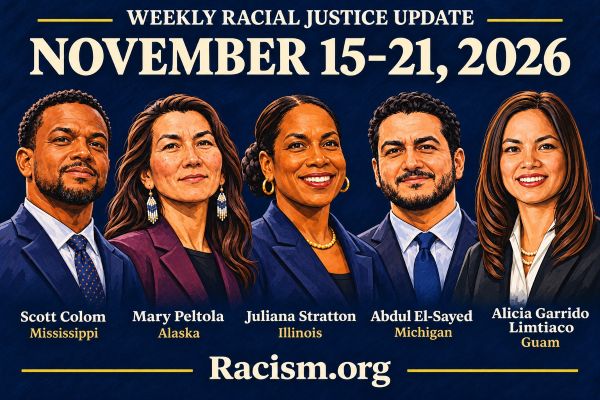
Vernellia R. Randall, “Weekly Racial Justice Update, November 15–21, 2026,” Race, Racism and the Law.
Act by December 10 on two federal proposals affecting food assistance. The U.S. Department of Agriculture estimates that its proposed eligibility rule for the Supplemental Nutrition Assistance Program (SNAP) would take benefits away from 6.3 million people by fiscal year 2029. A second proposal changes how states apply the three-month limit on benefits for certain adults. Each proposal has its own docket. If these rules affect your household or the people you serve, tell USDA what losing those benefits would mean.
Black representation will reach a record in the U.S. Senate, while both published tallies show a decline in the House. Mississippi elected Scott Colom, its first Black U.S. senator since Reconstruction. Alaska elected Mary Peltola, its first Alaska Native U.S. senator. This week’s counts also document Muslim victories from Congress to city councils and Indigenous victories in local government across the country. Now voters must watch what those officials do with the power they’ve been given.
Table of contents
- Food assistance | Two SNAP proposals are open for public comment
- Alaska Native political representation | Mary Peltola elected to the U.S. Senate
- Asylum seekers | A family of six received four days to prepare for a hearing
- Black families and Medicaid | Reporting rules put health coverage at risk
- Black political representation | U.S. Congress and state governments
- Black renters in New York | A text message becomes evidence in a fair housing lawsuit
- Haitian asylum seekers in Florida | Federal judge orders release after bond review was denied
- Indigenous political representation | New Mexico governor and 75 local victories nationwide
- Korean American family in California | Mother sues over response to alleged anti-Asian attack
- Latino communities in Virginia | Residents challenge warrantless ICE arrests
- Muslim political representation | U.S. Congress, state offices, and local government
- Muslim civil rights in Florida | State designation disrupts access to legal help
- Sikh political advocacy | Federal court sentences man who plotted to kill a U.S.-based activist
- Tribal sovereignty and Black environmental justice | Senate passes permitting bill
1. Food assistance | Two SNAP proposals are open for public comment
The published deadline for both proposals is December 10, 2026. Organizations representing state and local governments requested 60 additional days to respond to each proposal. The federal notices reviewed on November 22 listed December 10.
| Proposal | Docket |
|---|---|
| Narrow how families qualify for SNAP. USDA would limit which forms of Temporary Assistance for Needy Families count toward automatic eligibility. The agency estimates that 3.2 million households containing 6.3 million people would lose SNAP in fiscal year 2029, the first year it expects the proposal’s full effects. | FNA-2026-0661 |
| Change how states apply the SNAP work time limit. The proposal addresses who is subject to the three-month limit, when an area qualifies for a waiver, and how states define homelessness. | FNA-2025-0368 |
Why it matters
USDA found that 24.4% of Black non-Hispanic households experienced food insecurity in 2024, compared with 10.1% of white non-Hispanic households. USDA must explain how narrowing eligibility would affect families already facing that gap. The work-limit proposal raises a separate issue for Native communities. Some people who live on reservations fall outside the federal definitions that qualify individuals for an exemption. For them, an area waiver can determine whether the time limit applies.
Act by December 10. Put the docket number on your comment. Families can explain what losing grocery benefits would mean at home. Food banks, Tribal governments, and state agencies can document who would lose assistance locally and whether other programs can meet the need.
Sources
- Federal Register, SNAP categorical eligibility proposal, November 10, 2026. https://www.govinfo.gov/content/pkg/FR-2026-11-10/html/2026-22936.htm
- Federal Register, SNAP work requirements proposal, November 10, 2026. https://www.govinfo.gov/content/pkg/FR-2026-11-10/html/2026-22944.htm
- USDA Economic Research Service, Household Food Security in the United States in 2024. https://ers.usda.gov/sites/default/files/_laserfiche/publications/113623/ERR-358.pdf
- National Conference of State Legislatures, work requirements extension request, November 16, 2026. https://www.ncsl.org/resources/details/ncsl-comments-on-snap-work-requirements-rule
- National Conference of State Legislatures, categorical eligibility extension request, November 17, 2026. https://www.ncsl.org/news/details/ncsl-comments-on-proposed-snap-work-requirements
2. Alaska Native political representation | Mary Peltola elected to the U.S. Senate
U.S. Senate. On November 17, news outlets called Alaska’s Senate race for Mary Peltola, who is Yup’ik. She defeated incumbent Dan Sullivan and became the first Alaska Native elected to the U.S. Senate. Peltola previously represented Alaska in the U.S. House.
Voter participation. In the Tlingit village of Klukwan, 50 of 70 registered voters cast ballots. KHNS reported on November 18 that Klukwan had the highest turnout of any Alaska precinct in the unofficial figures then available. Chilkat Indian Village President Kimberley Strong said the Tribal council and administration sent out a reminder to vote.
Why it matters
Klukwan’s turnout shows what local organizing can do. Tribal leaders asked residents to vote, and more than seven in ten registered voters did. Peltola has named high prices as a priority. Alaska Native communities can ask what she does in the Senate to bring down the cost of food and other essentials.
Sources
- Native News Online, November 17, 2026. https://nativenewsonline.net/currents/breaking-news-mary-peltola-yupik-wins-senate-seat-in-alaska/
- KHNS/KTOO, November 18, 2026. https://www.ktoo.org/2026/11/18/klukwan-had-alaskas-highest-turnout-for-the-general-election/
- Associated Press, republished by The Washington Post, November 18, 2026. https://www.washingtonpost.com/politics/2026/11/18/alaska-senate-peltola-sullivan-democrats/f1748012-e3a8-11f1-a99e-b3e3805c6b8b_story.html
3. Asylum seekers | A family of six received four days to prepare for a hearing
On November 16, The Guardian reported that a New Orleans immigration lawyer received four days’ notice to prepare a family of six for a virtual asylum hearing before a judge in Cleveland. The court had already moved the hearing forward from July 2028. A government lawyer asked the judge to deny the asylum application without a full hearing on the evidence.
Why it matters
Four days can decide what evidence a judge ever sees. A family may need documents from another country, translations, and time for witnesses to explain what happened. When a court moves up a hearing, the family bears the consequences of every piece of evidence it cannot gather in time.
Source
- The Guardian, November 16, 2026. https://www.theguardian.com/us-news/2026/nov/16/trump-immigration-courts-families-mass-deportations
4. Black families and Medicaid | Reporting rules put health coverage at risk
On November 17, Word In Black examined what new Medicaid work requirements mean for Black families. Certain adults must document 80 hours a month of qualifying activities, which can include work, education, or volunteering. States that choose the federal transition option will still check whether people meet the requirement or qualify for an exemption. Through June 30, 2027, those states will protect otherwise eligible people from losing or being denied coverage solely for failing to meet the work requirement.
Why it matters
A worker can complete every required shift and still lose health coverage if the state fails to verify the hours. Black Americans rely on Medicaid at disproportionately high rates. State agencies must tell residents whether they will use the transition period, publish coverage losses by race, and explain how quickly they correct errors.
Sources
- Word In Black, November 17, 2026. https://wordinblack.com/2026/11/medicaid-delay-gives-black-americans-more-time-but-coverage-risks-remain/
- Centers for Medicare & Medicaid Services, November 13, 2026. https://www.cms.gov/newsroom/press-releases/cms-announces-hold-harmless-period-strengthen-medicaid-work-requirement-systems-improve-beneficiary
5. Black political representation | U.S. Congress and state governments
U.S. House. Both published tallies put Black representation below the current 61 voting members. Reuters counted 58 seats on November 21. The Joint Center for Political and Economic Studies counted 59 in its November 13 update. Two Louisiana runoffs involving Black candidates Chauna Banks and Patricia Moore are scheduled for December 12. Across Congress, Reuters counted 13 newly elected Black Democrats, the largest incoming group since 1993.
U.S. Senate. Mississippi voters elected Scott Colom, who defeated incumbent Cindy Hyde-Smith in a race the Associated Press called on November 11. Colom is Mississippi’s first Black U.S. senator since Reconstruction and the first Black U.S. senator directly elected by Mississippi voters. The state legislature elected Mississippi’s two previous Black senators, Hiram Revels and Blanche Bruce. Colom’s victory and Juliana Stratton’s win in Illinois bring Black representation in the Senate from five members to a record seven when the new Congress convenes.
Governors. Georgia elected Keisha Lance Bottoms, the first Black woman elected governor in U.S. history. Byron Donalds in Florida, Aaron Ford in Nevada, and David Crowley in Wisconsin became the first Black governors elected in their states. Maryland reelected Wes Moore. Five Black governors are set to serve at the same time, a national first.
State attorneys general. Georgia elected Tanya Miller, the first Black woman elected attorney general in the state. Voters also reelected Anthony Brown in Maryland, Andrea Campbell in Massachusetts, Keith Ellison in Minnesota, Letitia James in New York, and Kwame Raoul in Illinois.
State legislatures. Georgia House Democrats nominated Carolyn Hugley for speaker. If the full chamber elects her in January, she will become Georgia’s first Black House speaker. She named Medicaid expansion as a top priority. In Florida, state Senate Democrats chose Tracie Davis as their leader and Mack Bernard as leader pro tempore for the 2026–28 term.
Why it matters
Black Mississippians fought for generations to exercise the right to vote. This year, Mississippi voters used that right to elect a Black U.S. senator directly for the first time. Colom must answer to those voters for how he uses his office to protect ballot access and defend federal voting rights.
The Senate gains and the lower House tallies matter when voting rights and food assistance come up for a vote. At the state level, governors must show what their budgets deliver for Black communities, and attorneys general must explain how they respond to discrimination. In Georgia, watch whether Medicaid expansion gets a hearing and a vote.
Sources
- Reuters, November 21, 2026. https://www.reuters.com/world/us/most-new-black-democrats-decades-join-us-congress-set-sway-policy-party-2026-11-21/
- Joint Center for Political and Economic Studies, updated November 13, 2026. https://jointcenter.org/black-representation-in-the-2026-midterm-elections/
- Mississippi Today, Colom election result, November 11, 2026. https://mississippitoday.org/2026/11/11/scott-colom-wins-senate-mississippi-hyde-smith/
- Mississippi Today, history of Mississippi’s Black senators, November 12, 2026. https://mississippitoday.org/2026/11/12/scott-colom-mississippi-other-black-senators/
- Associated Press, republished by CityNews, November 11, 2026. https://toronto.citynews.ca/2026/11/11/mississippi-elects-democrat-scott-colom-as-states-first-black-us-senator-since-reconstruction/
- Mississippi Today, Black gubernatorial victories, November 5, 2026. https://mississippitoday.org/2026/11/05/winning-black-candidates-make-history-governor/
- Georgia Secretary of State, November 3, 2026 election results. https://results.sos.ga.gov/results/public/Georgia/11032026GeneralAndSpecialElection
- The Community Voice, November 6, 2026. https://www.communityvoiceks.com/2026/11/06/eight-women-georgia-statewide-offices/
- Ballotpedia, 2026 attorney general election results. https://ballotpedia.org/Election_results,_2026:_Attorneys_General
- Georgia Public Broadcasting, November 12, 2026. https://www.gpb.org/news/2026/11/12/house-democrats-nominate-leadership-after-winning-majority-for-the-first-time-in
- Florida Senate Journal, November 17, 2026. https://www.flsenate.gov/Session/Journals/2026/11-17-2026
6. Black renters in New York | A text message becomes evidence in a fair housing lawsuit
Lisa Renee Olaso and her fiancé, Cyril Christopher, traveled from Delaware to Queens to look at an apartment. Before they went inside, Olaso received a text that read, “Ugh. They are Black.” The couple alleges that the real estate agent meant to send it to the owner. They sued the agent, the brokerage, and the property owners in October. In a November 16 report, USC’s Center for Health Journalism said the brokerage learned of the incident through the suit and terminated the agent.
Why it matters
A Black renter may be told that an apartment is unavailable and never learn whether race played a part. Fair housing testing can show whether an agent gives a different answer to a similarly qualified white applicant. Enforcement cannot depend on a racist text reaching the wrong phone.
Source
- USC Center for Health Journalism, November 16, 2026. https://centerforhealthjournalism.org/our-work/insights/health-divide-racist-text-exposes-housing-problem-thats-usually-hidden
7. Haitian asylum seekers in Florida | Federal judge orders release after bond review was denied
On November 19, U.S. District Judge Sheri Polster Chappell ordered the federal government to release Welnayder Charlesma within 24 hours. Charlesma entered the United States through the Haitian humanitarian parole program in 2023. He had a pending asylum claim, work authorization, and no criminal record. After his August arrest, an immigration judge concluded that he lacked authority to consider bond. Judge Chappell ruled that the government applied the wrong detention law and violated Charlesma’s right to due process. The date he left custody remains unverified.
Why it matters
By classifying Charlesma as an “arriving alien,” the government denied him a chance to ask an immigration judge for release on bond. He had lived in the United States for more than three years. It took a separate federal case to enforce his right to due process.
Source
- U.S. District Court, Middle District of Florida, November 19, 2026. https://ecf.flmd.uscourts.gov/cgi-bin/show_public_doc?2026-02984-7-2-cv=
8. Indigenous political representation | New Mexico governor and 75 local victories nationwide
Governor. On November 3, New Mexico elected Deb Haaland, a member of the Pueblo of Laguna and the first Native American woman elected governor of a U.S. state.
Local government. In a tally reported November 19, Underscore Native News and ICT tracked 75 Indigenous candidates who won local offices nationwide, including seats on city councils, borough assemblies, and school boards. In Alaska, 28 of the 40 Indigenous candidates tracked won their October races. They included Cyrus Harris, who is Iñupiaq, on the Northwest Arctic Borough Assembly.
Why it matters
Haaland’s administration must show how it works with Tribal Nations when it sets spending priorities. Local officials have decisions to answer for as well. Do school budgets meet Native students’ needs? Do borough and city budgets fund the roads and services Indigenous communities have asked for?
Sources
- Reuters, November 4, 2026. https://www.reuters.com/world/us/democratic-victories-bring-historic-breakthroughs-women-minorities-2026-11-04/
- Underscore Native News and ICT, November 19, 2026. https://ictnews.org/politics/election-2026/75-indigenous-candidates-nationwide-elected-to-local-seats/
9. Korean American family in California | Mother sues over response to alleged anti-Asian attack
Julie Choi filed suit in Los Angeles County on November 18 over a May incident at an In-N-Out restaurant in Sherman Oaks. Choi alleges that another customer used anti-Asian slurs and shoved her 17-year-old daughter, and that employees failed to intervene. The company’s liability remains a question for the court.
Why it matters
Businesses must train employees to respond when someone targets a customer with racial abuse. A teenager and her family should be able to count on staff to intervene safely and get help.
Sources
- Los Angeles Times, November 19, 2026. https://www.latimes.com/california/story/2026-11-19/in-n-out-sued-over-alleged-failure-to-stop-anti-asian-attack-in-san-fernando-valley
- Quartz, November 20, 2026. https://qz.com/in-n-out-sued-alleged-anti-asian-attack-sherman-oaks-112026
10. Latino communities in Virginia | Residents challenge warrantless ICE arrests
On November 16, the Centreville Immigration Forum and six Virginia residents sued federal immigration officials. They allege that officers detained people they perceived as Latino without warrants or the facts required to justify a warrantless arrest. One plaintiff, Britney Ramirez Corona, is an 18-year-old U.S. citizen. She says officers detained her in Norfolk when she went to retrieve her fiancé’s car after his arrest.
Why it matters
An 18-year-old U.S. citizen says she went to pick up a car and ended up in ICE custody. The government must explain what its officers knew about her before detaining her. The same question applies to every arrest challenged in this case.
Sources
- Centreville Immigration Forum et al. v. U.S. Department of Homeland Security et al., complaint filed November 16, 2026. https://www.justice4all.org/wp-content/uploads/2026/11/Warrantless-Arrest_Complaint_.pdf
- ACLU of Virginia, case summary, November 16, 2026. https://www.acluva.org/cases/centreville-immigration-forum-et-al-v-u-s-department-of-homeland-security-et-al/
- The Washington Post, November 16, 2026. https://www.washingtonpost.com/dc-md-va/2026/11/16/lawsuit-accuses-ice-illegally-arresting-virginia-residents-without-warrants/
11. Muslim political representation | U.S. Congress, state offices, and local government
On November 17, the Council on American-Islamic Relations (CAIR) and CAIR Action reported 115 confirmed Muslim election victories in 21 states in the November 3 elections, including 45 wins for statewide or legislative offices. Counting earlier elections, the organizations reported at least 126 Muslim Americans elected in 2026.
U.S. House. Seven Muslim candidates won House seats. Voters reelected André Carson of Indiana, Ilhan Omar of Minnesota, Lateefah Simon of California, and Rashida Tlaib of Michigan. Adam Hamawy became the first Muslim elected to represent New Jersey in Congress, and Darializa Avila Chevalier became the first elected to represent New York. California’s Aisha Wahab won a full term after winning an August special election.
U.S. Senate. Michigan elected Abdul El-Sayed, the first Muslim elected to the U.S. Senate. The former public health official campaigned on lowering costs for working families and expanding access to healthcare.
State offices. Minnesota reelected Keith Ellison as attorney general. Aber Kawas won a New York State Senate seat, becoming the first Palestinian American Muslim woman elected to the state legislature. Georgia elected Muslim candidates to both chambers, including Ruwa Romman to the state Senate and Farooq Mughal to the state House.
Local government. Yousef Rabhi won the mayor’s race in Ann Arbor, Michigan. Medinah Muhammad won a seat on the Essex County Board of Commissioners in New Jersey, and Sana Siddiqui won an at-large seat on the Raleigh City Council in North Carolina.
Why it matters
Some Muslim candidates faced anti-Muslim attacks during the campaign. Now voters can judge these officials by the record they build. Members of Congress must answer for their votes on healthcare and civil rights. State and local officials must show what they do when Muslim residents report discrimination in schools, workplaces, or public services.
Sources
- Reuters, November 4, 2026. https://www.reuters.com/world/us/abdul-el-sayed-becomes-first-muslim-elected-us-senate-2026-11-04/
- The Final Call, November 16, 2026. https://new.finalcall.com/2026/11/16/muslim-electoral-gains-bring-new-expectations-and-a-test-of-political-power/
- CAIR and CAIR Action, November 17, 2026. https://www.cair.com/press_releases/a-historic-turning-point-cair-cair-action-confirm-record-126-american-muslims-win-elected-office-in-2026/
12. Muslim civil rights in Florida | State designation disrupts access to legal help
In a November 20 update, CAIR described its appeal over Florida’s designation of CAIR and its Florida chapter as “domestic terrorist organizations.” The district court allowed most of the challenged state law to take effect on November 5 while the case continued. The ACLU of Florida said the groups suspended their Florida advocacy and legal services while pursuing the appeal.
Why it matters
A Muslim worker facing religious harassment or a parent challenging discrimination at school may need help immediately. The suspension takes away a place Floridians could turn while the courts decide whether the state acted lawfully.
Sources
- CAIR California, November 20, 2026. https://ca.cair.com/updates/an-important-update-on-cair-florida-and-texas/
- ACLU of Florida, November 5, 2026. https://www.aclufl.org/press-releases/cair-and-cair-florida-will-appeal-federal-court-decision-denying-relief-from-floridas-unconstitutional-terrorist-designation-regime/
13. Sikh political advocacy | Federal court sentences man who plotted to kill a U.S.-based activist
On November 20, a federal court in New York sentenced Nikhil Gupta to 235 months in prison for his role in a plot to kill a U.S. citizen who advocates for a separate Sikh state. The Justice Department said Gupta acted at the direction of an Indian government employee.
Why it matters
Sikh Americans have the right to organize in this country and criticize a government abroad. A plot against one advocate can intimidate others who speak at a public meeting, organize a demonstration, or sign a petition. Officials must hold accountable those who use threats and violence to silence political speech.
Source
- U.S. Department of Justice, Southern District of New York, November 20, 2026. https://www.justice.gov/usao-sdny/pr/indian-national-sentenced-235-months-prison-plotting-assassinate-us-citizen-new-york
14. Tribal sovereignty and Black environmental justice | Senate passes permitting bill
On November 19, the Senate voted 62–33 to pass the Bipartisan American Affordability and Jobs Act as H.R. 2347, as amended. The National Congress of American Indians called on Congress to remove Division B, Title III, which changes the historic preservation review known as Section 106. More than 70 Tribal Nations were represented in materials opposing the proposed changes. In a November 18 Word In Black commentary, Robert Bullard warned that faster approvals could also give Black residents less opportunity to protect their neighborhoods and historic places.
Why it matters
Federal agencies must consult Tribal Nations while there is still time to protect burial grounds and sacred places. Congress must also answer for what shorter reviews mean for Black neighborhoods. Bullard points to highways that cut through Black communities. Residents need time to challenge a project before a route is set and their homes, businesses, or historic places are put at risk.
Sources
- U.S. Senate Daily Press, November 19, 2026. https://www.dailypress.senate.gov/thursday-november-19-2026/
- National Congress of American Indians, November 16, 2026. https://www.ncai.org/news/ncai-calls-for-withdrawal
- Robert Bullard, Word In Black, November 18, 2026. https://wordinblack.com/2026/11/a-new-infrastructure-bill-raises-old-fears-for-black-america/
- Native News Online, November 20, 2026. https://nativenewsonline.net/sovereignty/despite-strong-tribal-opposition-u-s-senate-approves-baaja-in-late-night-vote/
Bottom line
Comment by December 10. Tell USDA what losing SNAP would mean for Black families already facing higher rates of food insecurity. Tribal governments and Native organizations can use the work-limit docket to explain who could lose benefits if their area cannot get a waiver.
Ask your U.S. House member whether they will remove Title III, work directly with Tribal Nations, and give Black residents time to challenge projects that threaten their homes, businesses, or historic places.
Sources last checked through live web research on November 22, 2026.
Vernellia R. Randall, Professor Emerita of Law, University of Dayton School of Law. This article was drafted with the assistance of ChatGPT, an AI language model. ChatGPT assisted with live source discovery, source comparison, organization, and drafting. Professor Randall retains responsibility for editorial review and publication decisions.