
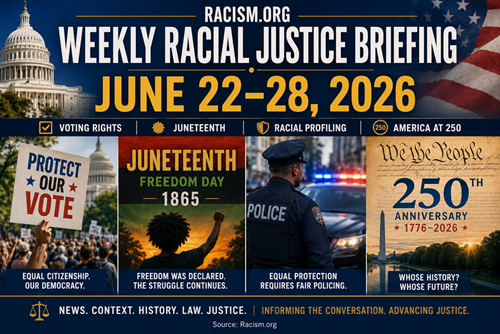
Vernellia Randall, Weekly Racial Justice Briefing: June 22–28, 2026, racism.org (June 29, 2026)
Table of Contents
- Why It Matters
- Voting Rights and Equal Citizenship
- Juneteenth: Measuring the Distance Between Freedom and Equality
- Policing and Equal Protection: Racial Profiling Beyond U.S. Borders
- Reimagining America at 250: Whose History Will We Tell?
- Voices from the Community
- Looking Ahead
- What We're Watching
Why It Matters
The most significant racial justice developments during the week of June 22–28, 2026, focused on a single issue: equal citizenship. Although the week's stories addressed voting rights, Juneteenth, policing, and the nation's approaching 250th anniversary, each raised the same underlying question: How fully are the promises of American democracy being realized for communities of color?
Voting rights remained the dominant issue. Families whose relatives were killed in the struggle to secure voting rights warned that recent court decisions are weakening protections that cost lives to achieve. At the same time, Black media used the conclusion of Juneteenth celebrations to remind readers that emancipation marked the beginning—not the end—of the struggle for equal citizenship.
Outside the United States, allegations of racial profiling in Montréal illustrated that concerns about discriminatory policing continue to extend beyond national borders. Meanwhile, organizations preparing for the nation's 250th anniversary argued that any meaningful commemoration must include the histories of slavery, Indigenous dispossession, immigration exclusion, and the continuing struggle for civil rights.
Taken together, this week's developments demonstrate that racial justice remains closely connected to the law. Questions about voting, policing, public memory, and equal protection all influence whether constitutional guarantees become lived realities for all Americans.
Voting Rights and Equal Citizenship
Summary
Voting rights remained the most significant racial justice issue of the week.
An Associated Press report highlighted the concerns of families whose relatives died during the modern Civil Rights Movement, including relatives of James Chaney, Andrew Goodman, Michael Schwerner, Viola Liuzzo, Vernon Dahmer, and the four girls killed in the bombing of the 16th Street Baptist Church. Many believe recent Supreme Court decisions and state redistricting efforts are weakening protections secured through decades of sacrifice.
Capital B examined the issue through the experience of Black voters in Alabama. Its reporting described how recent litigation over congressional district boundaries could reduce opportunities for Black voters to elect candidates of their choice. The article illustrates how changes in election law continue to affect political representation in states with long histories of racial discrimination in voting.
The Brennan Center for Justice placed these developments within a broader historical context, arguing that Juneteenth reminds Americans that freedom and political equality have always required continued legal protection. The organization noted that expanding citizenship rights has historically been followed by efforts to limit their practical effect, making voting rights a continuing civil rights issue rather than a settled question.
Why It Matters
The right to vote determines who participates in making the laws that govern education, healthcare, housing, employment, criminal justice, environmental protection, and other areas affecting daily life.
When legal protections for voting are weakened, the consequences extend beyond elections. They influence whether communities have an effective voice in shaping the public policies that affect their lives.
Bottom Line
This week's reporting demonstrates that voting rights remain central to racial justice because political participation influences every other aspect of equal citizenship.
Sources
Associated Press. Fields, Gary. (June 27, 2026). Some Paid the Ultimate Price to Enact Voting Rights. Their Survivors See America Turning Backward. AP News. Visited June 30, 2026.
https://apnews.com/article/51dde3f92534a35fcd3873312491abae
Brennan Center for Justice. Degraffenreid, Veronica. (June 16, 2026). Juneteenth and the Unfinished Fight for Voting Rights. Brennan Center for Justice. Visited June 30, 2026.
https://www.brennancenter.org/our-work/analysis-opinion/juneteenth-and-unfinished-fight-voting-rights
Capital B. Tensley, Brandon. (June 3, 2026). Black Alabama Voters Lose Again as Supreme Court Greenlights Map. Capital B. Visited June 30, 2026.
https://capitalbnews.org/supreme-court-voting-rights-act-black-voters
Juneteenth: Measuring the Distance Between Freedom and Equality
Summary
Although Juneteenth celebrations concluded the previous week, Black media continued to emphasize that the holiday is not simply about commemorating the end of slavery. Instead, it is an opportunity to evaluate how far the nation has progressed toward fulfilling the promises of freedom, citizenship, and equal opportunity.
Several opinion pieces published by AFRO American Newspapers argued that Juneteenth should remain connected to current public policy debates, including voting rights, economic opportunity, reparations, community safety, and equal protection under the law. Rather than treating emancipation as the conclusion of America's racial history, the articles described it as the beginning of an ongoing effort to secure equal citizenship.
One commentary urged readers to move beyond symbolic recognition by building institutions and public policies that protect communities disproportionately affected by discrimination and violence. Another reflected on how delayed emancipation illustrates the continuing gap between legal rights and lived experience.
Collectively, these articles framed Juneteenth as both a historical milestone and a continuing measure of the nation's commitment to racial justice.
Why It Matters
Juneteenth commemorates the end of legalized slavery in the United States, but it also reminds us that legal freedom alone has never guaranteed equal treatment.
The history of Reconstruction, Jim Crow, segregation, voter suppression, housing discrimination, unequal education, and continuing racial disparities demonstrates that constitutional rights must be protected through law, public policy, and civic engagement if they are to become meaningful in everyday life.
Bottom Line
Juneteenth is more than a celebration of emancipation. It is an annual opportunity to examine whether the promises of freedom and equal citizenship have been realized.
Sources
AFRO American Newspapers. (June 18, 2026). An Unfinished Freedom: Juneteenth and the Ongoing Struggle for Equity. Visited June 30, 2026.
https://afro.com/juneteenth-reflection-on-progress/
AFRO American Newspapers. Draper, Frances Toni. (June 19, 2026). Juneteenth, Justice and America's Double Standard. Visited June 30, 2026.
https://afro.com/juneteenth-delayed-justice-america/
AFRO American Newspapers. Moore, Candace. (June 19, 2026). This Juneteenth Let's Build Systems to Protect Those Most Impacted by Harm. Visited June 30, 2026.
https://afro.com/juneteenth-celebration-power-communities/
Policing and Equal Protection: Racial Profiling Beyond U.S. Borders
Summary
This week also brought renewed attention to racial profiling in policing. In Montréal, city officials called for an end to random police stops after allegations that Black and Arab residents were disproportionately subjected to police checks. The investigation reportedly involves multiple officers and has renewed public debate about police accountability and discriminatory enforcement practices.
Although the events occurred in Canada, the issues are familiar throughout North America. Civil rights advocates have long argued that discretionary policing practices—including pedestrian stops, traffic stops, surveillance, and investigatory encounters—often produce racially disparate outcomes even when they appear neutral on their face.
The Montréal investigation illustrates that concerns about racial profiling are not unique to the United States. Democracies across the globe continue to struggle with balancing public safety, police discretion, and equal protection for racial and ethnic minorities.
Why It Matters
Equal protection depends not only on the laws that governments enact but also on how those laws are enforced.
When members of particular racial or ethnic communities experience greater police scrutiny than others, public confidence in law enforcement and the justice system is undermined. Addressing racial profiling therefore remains an important component of protecting civil rights and maintaining public trust.
Bottom Line
The Montréal investigation serves as a reminder that racial profiling remains an international civil rights concern and that equal protection requires fair and impartial law enforcement.
Sources
The Guardian. Cecco, Leyland. (June 22, 2026). Montreal Mayor Calls for End to Random Police Checks Amid Racial Profiling Investigation. Visited June 30, 2026.
https://www.theguardian.com/world/2026/jun/22/montreal-mayor-random-police-checks-racism-investigation
Reimagining America at 250: Whose History Will We Tell?
Summary
As the United States prepares to commemorate the 250th anniversary of the Declaration of Independence in 2026, advocacy organizations are urging the nation to use the occasion to examine both its achievements and its failures.
The Next250 coalition unveiled a Declaration of Interdependence, developed through listening sessions held across the United States and with participants abroad. Rather than presenting the anniversary solely as a patriotic celebration, organizers described it as an opportunity to strengthen democracy by recognizing the experiences of communities historically excluded from the nation's founding promises.
Participants identified issues including racial justice, Indigenous rights, immigration, economic opportunity, healthcare, education, environmental justice, and democratic participation as essential components of the nation's future. The initiative argues that the country's next 250 years should be shaped by a broader understanding of American history—one that includes slavery, segregation, Indigenous dispossession, exclusionary immigration policies, and the continuing struggle for civil rights.
Why It Matters
National anniversaries influence how societies understand their history and define their future.
The stories a nation chooses to celebrate—or ignore—help shape public memory, civic identity, and public policy. As the United States marks its semiquincentennial, debates over historical interpretation are likely to become increasingly important.
Bottom Line
The nation's 250th anniversary is becoming more than a historical celebration. It is also becoming a national conversation about whose experiences and contributions are included in the American story.
Sources
The Guardian. Cineas, Fabiola. (June 27, 2026). "This Isn't About Any One Administration": Protests in DC Reimagine the Next 250 Years in the US. Visited June 30, 2026.
https://www.theguardian.com/us-news/2026/jun/27/next250-declaration-of-interdependence-art-gallery
Voices from the Community
This week's community perspective comes from AFRO American Newspapers, whose Juneteenth coverage consistently emphasized that emancipation marked the beginning—not the completion—of the struggle for equal citizenship.
Rather than treating Juneteenth solely as a historical celebration, AFRO's reporting connected the holiday to present-day discussions about voting rights, community investment, public safety, economic opportunity, and equal protection under the law.
That perspective reflects a broader theme found throughout this week's reporting. Legal rights matter, but their value ultimately depends on whether they are fully realized in people's daily lives.
Bottom Line
Community-based journalism continues to provide perspectives that are often underrepresented in mainstream reporting while highlighting how current events affect the daily lives of historically marginalized communities.
Looking Ahead
Several issues are likely to shape racial justice reporting during the coming weeks:
- Continued litigation involving voting rights and congressional redistricting.
- Federal and state litigation affecting diversity, equity, and inclusion initiatives.
- Immigration and citizenship policies affecting communities of color.
- Police accountability and racial profiling.
- Activities associated with the nation's 250th anniversary and the public conversations they generate.
What We're Watching
Voting Rights
Recent court decisions are likely to generate additional litigation over congressional districts, election administration, and minority voting rights. These cases will continue to influence political representation at the federal, state, and local levels.
The 250th Anniversary
Organizations across the country are developing programs marking the nation's semiquincentennial. An important question will be whether those commemorations present a broad and inclusive history or focus primarily on traditional narratives.
Community-Based Journalism
Black, Indigenous, Latino, Asian American, and other community-based news organizations continue to provide reporting and perspectives that are often absent from mainstream coverage. Their reporting will remain an important part of future Weekly Racial Justice Briefings.
Vernellia R. Randall, Professor Emerita of Law, University of Dayton School of Law.
Racism.org Weekly Racial Justice Briefing is produced by Racism.org using editorial oversight, live source verification, and AI-assisted drafting. Every edition is reviewed before publication to support accuracy, transparency, and informed public discussion of race, racism, and the law.